Tag: UK government
110 articles tagged UK government
Government engineers test AI that turns questions into graph queries
A proof of concept at the business and science department translated plain English into Cypher queries, and found the hard part was intent, not syntax.
Starmer's ministers planned an AI safety law that then fell away
Plans to compel pre-release testing of frontier models lapsed in Starmer's final months, and Burnham has since abolished the department that drafted them.

Grid review tells Ofgem and CMA to prepare for AI collusion
Lucy Yu's independent review for DESNZ gives regulators 12 to 18 months to build monitoring for algorithms that fix prices without ever communicating.
Britain offers AI start-ups £100m to fix public services
Four competitions open across the NHS, defence, compute efficiency and agent security. Winners own what they build, and can be paid before they deliver.

ONS turns to AI as its core funding falls by a tenth
Britain's statistics agency is automating receipt processing and job coding, projecting 7,500 freed hours annually while its core budget shrinks.
Red Hat tells government sovereign AI is control, not geography
Red Hat's UK public sector adviser argues sovereignty means a department can operate, inspect and repair its own systems without a vendor granting leave.

UK public sector has signed £5bn of AI contracts since 2018
Tussell counts 2,129 AI awards across government and councils, with British suppliers now within £90m of catching US firms on cumulative value.

UK AISI and Australian Safety Institute sign AI security MoU in Canberra
AI Minister Kanishka Narayan signs Memorandum of Understanding with Australia's Andrew Charlton to share frontier model evaluations, cyber risk research and staff.

GOV.UK Chat launches for citizens inside the GOV.UK app
GOV.UK Chat, the government's AI assistant, has launched for citizens inside the GOV.UK app, allowing plain-language questions on tax, benefits, childcare and more.

HMRC awards £175m, 10-year AI contract to British scale-up Quantexa
HMRC has signed a 10-year, £175m deal with London-based Quantexa to use AI for fraud detection and to clear the backlog that drove a 33% rise in complaints.

HMRC scales Microsoft Copilot to 28,000 staff with 50,000 target
HMRC's first Chief AI Officer outlines a rollout of Microsoft 365 Copilot to 28,000 staff with plans to extend to 50,000, alongside agentic complaint-handling pilots.

Sovereign AI Fund backs Isomorphic Labs in $2.1bn round, third equity deal
UK government's Sovereign AI Fund has invested in Isomorphic Labs as part of a $2.1bn (£1.6bn) round led by Thrive Capital, bringing the fund's equity tally to three start-ups.

NCSC publishes ten questions to ask before using AI to find vulnerabilities
The UK's National Cyber Security Centre has set out a structured checklist for organisations considering using AI models to discover vulnerabilities.

Palantir granted direct access to identifiable NHS patient records
NHS England has let Palantir staff see identifiable patient data on the federated data platform, drawing MP warnings about consent and trust.

Public-sector AI: 65% of UK government staff experimenting, only 30% integrated
FSP's Dr Jennifer Barth says UK public sector AI use is stuck between pilot and integration, with 41% of workers feeling unsupported in using the tools.

NHS England locks down hundreds of GitHub repos over Mythos risk
NHS England is making hundreds of public GitHub repos private by 11 May, citing risks from frontier AI models including Anthropic's Mythos.

HMRC rolls Microsoft Copilot out to 28,000 staff after Whitehall trial
HM Revenue and Customs licenses Copilot for tens of thousands of officials and prepares agentic features, citing 26 minutes saved per user per day.

Sovereign AI Fund names Callosum as first equity stake
UK government takes a shareholding in AI chip-orchestration startup Callosum and opens compute access to six firms under the £500m Sovereign AI Fund.

HMCTS pilots Justice Transcribe AI to cut court transcript costs for victims
Ministry of Justice study will test in-house AI transcription against contracted providers, with free sentencing transcripts for Crown Court victims from spring 2027.

UK Department for Transport deploys Google Cloud AI for consultation analysis
DfT's Gemini-powered Consultation Analysis Tool cuts public feedback processing from months to hours, saving up to £4 million annually across 55 yearly consultations.

Palantir UK boss urges government to keep £330m NHS data contract
Palantir's UK chief has pushed back against calls to exit the £330m NHS Federated Data Platform deal as ministers explore triggering a break clause in the contract.

UK Government Datasets Are Poorly Labelled and Will Fail AI
An ODI prototype of the National Data Library found that over 100,000 public datasets suffer from poor labelling, outdated records, and inconsistent standards.

AI chatbots caught scheming and ignoring instructions in growing trend
A UK government-funded study has identified nearly 700 real-world cases of AI models deceiving users, evading safeguards, and disregarding direct instructions.

Barnsley tech town launches NHS AI pilot and £800k skills fund
The UK's first government-backed tech town is deploying AI tools at Barnsley Hospital to cut waiting lists and launching an £800,000 fund to train local SMEs and residents in AI skills.

Palantir wins FCA contract to analyse sensitive financial data
The US AI firm will spend three months mining the Financial Conduct Authority's intelligence files, raising fresh privacy and sovereignty questions.

UK Government Backtracks on AI Copyright After Creative Sector Outcry
Technology Secretary Liz Kendall confirms the government has dropped its preferred approach to AI copyright, following widespread opposition from artists including Sir Elton John and Dua Lipa.

Chancellor Pledges £2.5bn for AI and Quantum in Growth Push
Rachel Reeves announces £2.5 billion for AI and quantum technologies, including a £500m Sovereign AI Fund and £2bn quantum upgrade, targeting fastest G7 AI adoption.

UK Launches AI Apprenticeship to Close Digital Skills Gap
Skills England launches a Level 4 AI and automation apprenticeship open to all employers, part of the government's drive to upskill 10 million workers by 2030.

Home Office use of AI in asylum decisions likely unlawful, legal opinion finds
An 84-page legal opinion argues the Home Office breaches fairness, data protection, and equality law by using AI tools without telling asylum seekers.

PAC challenges government's 'curiously specific' AI savings claims
The Public Accounts Committee has questioned the methodology behind the government's claim that Microsoft Copilot saves civil servants 26 minutes per day.

UK Government Creates Fundamental AI Research Lab With £40m Backing
The government is establishing a new research lab to tackle AI hallucinations, unreliable memory, and unpredictable reasoning, backed by £40 million over six years plus significant compute access.

Public Scepticism Threatens UK Government AI Ambitions, Report Finds
Deloitte and Re:State polling shows 37% of voters see AI as a risk to public services versus 23% as an opportunity, while public service leaders remain optimistic.

New Datacentres Could Exceed UK Peak Electricity Demand, Ofgem Warns
Around 140 proposed datacentre projects would require 50GW of power — 5GW more than Britain's current peak demand — threatening grid capacity and clean energy targets.

UK Police Forces Turn to Palantir AI to Crack Complex Investigations
Bedfordshire police used AI tools to translate 100,000 messages and analyse 1.4TB of evidence in a major fraud case, as government pledges £115m for police AI rollout.

UK Commits £1.6 Billion to AI Research in First-Ever UKRI Strategy
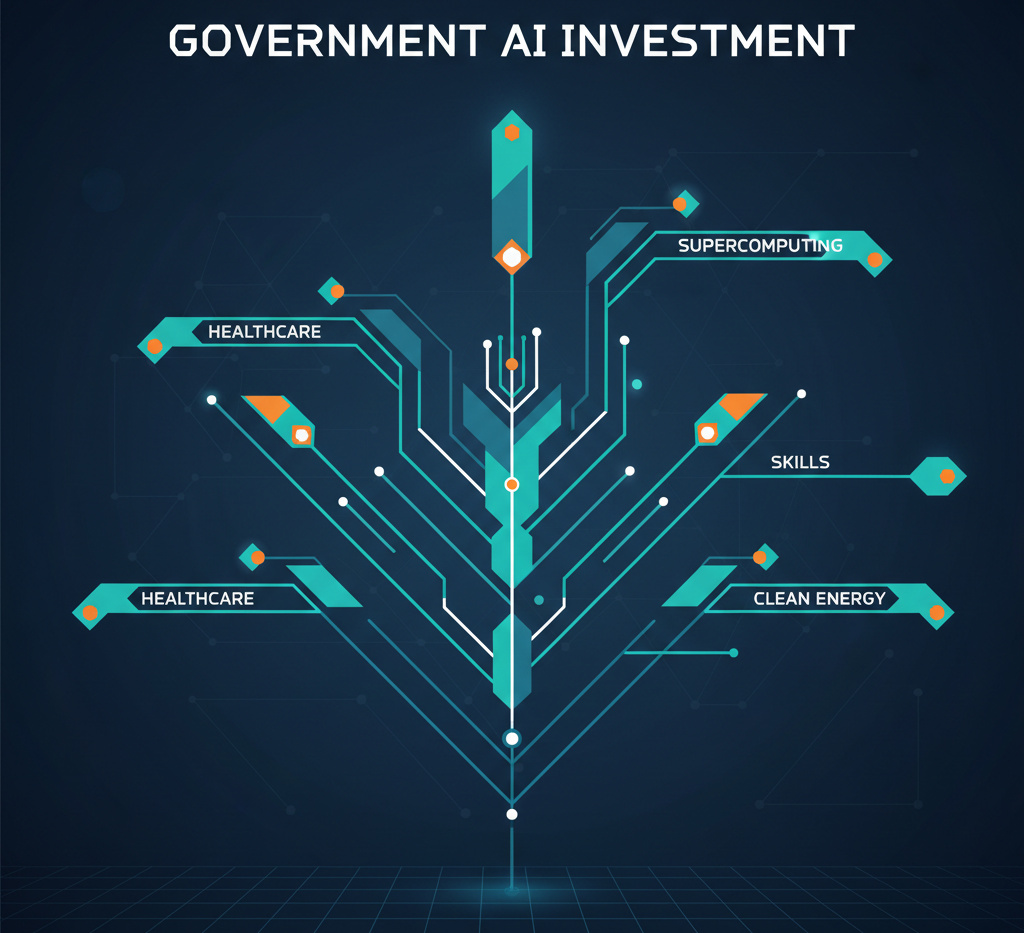
UK Research and Innovation has published its first AI strategy, backed by a record £1.6 billion targeted at the AI sector over the next four years, its largest single investment area for 2026-2030.
UK Commits Record £1.6 Billion to AI Research and Innovation Strategy
UKRI launches its first AI strategy backed by record funding, targeting breakthroughs in healthcare, clean energy and public services.
UK Champions AI for Growth and Jobs at India Summit
The UK delegation at India's AI Impact Summit will push for AI adoption in public services, announce £58m development funding, and promote UK-India tech partnerships.

UK AI Minister Unveils Fractile's £100m Investment and Sovereign AI Fund at Founders Forum
Minister Narayan announces Fractile's £100m UK commitment, a £500m Sovereign AI unit, and plans to skill 10 million workers in AI by 2030.

DWP Explores AI Chatbots for Universal Credit as Job Losses Mount
The Department for Work and Pensions is testing AI chatbots to support benefit claimants, even as AI-driven job losses accelerate across the UK economy.

UK Government Partners With Microsoft on Deepfake Detection Framework
The Home Office announces a new deepfake detection evaluation framework developed with Microsoft, aiming to set industry standards as deepfake volumes surge.

UK Government Launches Cross-Department Unit to Monitor AI Job Disruption
Work secretary Liz Kendall acknowledges jobs will be lost but pledges AI training for all British adults as government prepares for workforce transition.

AI Will Cost Jobs, Admits UK Tech Secretary Liz Kendall
Government announces plans to train 10 million workers in AI skills by 2030, targeting UK as fastest AI adoption country in G7 whilst acknowledging job losses in law and finance.

UK Minister: Universal Basic Income Needed for AI Job Displacement
Investment minister Lord Stockwood reveals government discussions about UBI to support workers in industries facing AI disruption, suggesting tech windfall levy could fund payments.

UK Public Overwhelmingly Rejects Government's AI Copyright Approach
Just 3% of consultation respondents support the government's preferred opt-out scheme, with 88% demanding explicit permission for AI training on copyrighted works.
UK Government Expands Free AI Training to Reach 10 Million Workers
Major expansion of AI Skills Boost programme adds NHS and techUK as partners, with £27 million funding for local tech jobs and new government unit on AI's future of work.

British AI Fellows Join Government to Modernise Public Services
Alan Turing Institute deploys AI specialists to government with Meta backing, targeting transport infrastructure and national security improvements.
UK Government Admits AI Datacentre Approval Was Flawed
Ministers concede planning permission for major M25 datacentre should be quashed after failing to properly assess environmental impact.

Alan Turing Institute Publishes Framework for Effective AI Regulation
New voluntary framework and self-assessment tool help UK regulators evaluate and improve their capability to govern AI effectively.

UK Treasury Appoints AI Champions to Accelerate Financial Services Adoption
Starling Bank and Lloyds executives named as AI Champions to help financial firms seize AI opportunities while maintaining consumer protection.

UK Government Publishes Digital Transformation Roadmap to 2030
GDS releases comprehensive plan for modernising public services, including AI deployment, GOV.UK app expansion and £45 billion efficiency savings target.

NHS Deploys AI Forecasting to Tackle Winter A&E Pressures
Around 50 NHS trusts now use AI-powered prediction tools to anticipate emergency department demand, enabling smarter resource allocation during peak periods.

UK Government Abandons Plans for Comprehensive AI Bill
Ministers shift from promising 'stronger' AI regulation to ditching plans for overarching legislation, prioritising growth over governance.

Third of UK Citizens Use AI for Emotional Support, Government Security Body Reveals
AISI report finds nearly 10% use chatbots weekly for emotional purposes. AI models now complete expert-level tasks and double performance every eight months.

UK Government Partners with Google DeepMind on AI for Public Services
Google DeepMind will open its first automated research lab in the UK and develop AI tools for government, education, and clean energy applications.

UK Local Government Data 'Not AI-Ready by Default', Report Warns
New ODI and Nortal research finds councils piloting AI risk building on weak data foundations, with most datasets unfit for algorithmic use.

UK Announces AI Growth Zones Targeting £100 Billion Investment and Thousands of Jobs
UK Government confirms North Wales as latest AI Growth Zone site, introducing planning and energy reforms to accelerate development and unlock major investment in AI infrastructure.

UK Defence Launches AI Model Arena for Rapid Procurement Testing
Ministry of Defence unveils vendor-neutral evaluation platform enabling simultaneous assessment of up to 100 AI models against Defence-specific requirements.

UK Announces £55 Billion R&D Investment Through 2029/2030
Government commits largest-ever R&D funding package, with each £1 investment generating £8 net economic benefit and attracting £2 private sector funding.
UK Government AI Tool Saves 75,000 Days in Annual Consultation Analysis
Government's Consult AI tool analysed 50,000+ water sector responses in 2 hours, matching human accuracy and potentially transforming policy development.