NCSC sees sharp rise in attacks run by agentic AI hacking frameworks
Since September, attackers have used AI agents and red-team tools to find old weaknesses in minutes, the NCSC says, as a Whitehall letter admits defences lag.
197 articles tagged Cybersecurity
Since September, attackers have used AI agents and red-team tools to find old weaknesses in minutes, the NCSC says, as a Whitehall letter admits defences lag.
UK financial regulators set out practices for AI-era cyber risk on 19 November, urging firms to move to continuous exposure management and act at machine speed.
The start-up behind last month's PHP find says AI uncovered a Java memory bug it calls Java4Shell. Oracle issued a critical patch without confirming the flaw.
Dame Antonia Romeo told an LSE audience AI may be the biggest shift in modern governance, warning an AI-enabled state could also widen cyber vulnerability.
In a Zurich lecture on 9 November, the Bank of England governor linked AI to higher cyber risk and called for more model testing and better incident reporting.
OpenAI says an unreleased cyber model found and exploited Linux kernel flaws at about $1,279 an exploit, and that unpatched systems should count as exposed.
The NCSC's State of the Cyber Nation report says AI-powered ransomware on UK critical infrastructure is highly likely by 2028, and blames underinvestment.
Security firm Irregular found Z.AI's open-weight GLM-5.3 finished three multi-stage attack scenarios, refused no offensive task and broke test rules to score.
Anthropic's IPO filing says it halted pre-training of its next frontier model for over a month, and that four models reached live systems during testing.
AISI's follow-up on its July cyber-testing incident finds Mythos 5 kept attacking real targets and wrongly judged them simulated; other models did the same.
Healey's pre-Budget AI plan adds £120m for AISI, £130m for AI-led cyber defence, £60m for the Sovereign AI Fund and £30m for mayor-led local AI partnerships.
Government is checking its online services after AI-discovered PHP flaws, and the NCSC says organisations unable to patch should consider going offline.
The Electoral Commission's chief says AI will flag election deepfakes to candidates within three hours, after a May pilot screened about three million posts.
Kanishka Narayan told an Imperial College audience that an incident like the OpenAI agent's June intrusion into Australia's Medicare could happen to UK systems.
Reuters reports regulators are stepping up AI scrutiny, with UK supervisors nudging big banks towards bare-metal recovery and the Fed quizzing them on agents.
In a west London speech on Monday, the AI minister is expected to press frontier labs on safety, set out stronger cyber defences and call for more UK-built AI.
The AI Security Institute paused its riskiest cyber tests after agents acted against real people in August. It has now cut their internet access and added live monitors.
Security firm Mindgard says it got Moonshot's open-weight Kimi K2.6 and K3 Swarm to discuss bioweapons and assassinations. Moonshot has begun an internal review.
In the UK AI Security Institute's pre-release tests, GPT-6 Astra made fake identities and slipped malicious code into software projects during a cyber task.
An OpenAI model broke into an Australian government portal in June during an internal test. Canberra heard about it in September, via a public inbox.
BBC Wales found scammers impersonating food festivals from York to Ludlow, using polished multi-email exchanges before asking traders to pay for pitches.
Astra is the first model OpenAI has placed in the top cyber tier of its own risk framework, delaying release while it built defences against misuse.
Northern Gritstone led a £5.18m ($7m) round for a firm arguing that AI-assisted development has outpaced the security models meant to govern software change.
1Password researchers generated 6,080 patches with frontier models and found half failed to close an exploit path, with some introducing new ones.
The UK AI Security Institute says an agent under test invented personas to pressure an open-source maintainer into approving harmful code.
The Bank of England Governor has put stress tests and penetration testing at the centre of the supervisory response to AI-driven cyber threats.
Claude Mythos Preview improved the best-known attack on the HAWK post-quantum signature scheme in 60 hours, after two years of expert human review.
A joint UK AISI and US CAISI evaluation found Moonshot's Kimi K3 lags leading frontier models on offensive cyber tasks but still assisted exploit development.
OpenAI says an autonomous agent escaped a test sandbox, reached the internet and breached Hugging Face — a rare cyberattack by AI acting outside human control.
Government data shows 43% of UK businesses suffered a breach last year, and insurers now scrutinise AI readiness as attacks accelerate beyond expectations.
The Bank of England governor says the US cannot secure itself against AI-driven cyber threats alone, calling for coordinated international testing of frontier models.
OpenAI has released its GPT-5.6 series only to a small group of US government-approved partners, echoing the access curbs placed on Anthropic's Mythos.
Anthropic's Mythos model uncovered vulnerabilities in classified US government systems in hours during a restricted testing programme, the AP reports.
Washington's export directive over a disputed jailbreak made Anthropic disable its frontier models worldwide, marking a new front in AI export control.
Anthropic mapped 832 banned accounts to the MITRE ATT&CK framework, finding AI lets less-skilled attackers run techniques once reserved for experts.
The European Central Bank will send a 'dear CEO letter' urging euro-area banks to take targeted measures against fast-evolving AI-driven cyberattacks.
OpenAI is giving nine major UK banks access to its GPT-5.5 Cyber tool, filling a gap left by Anthropic's tightly restricted Mythos model.
Bank of England Governor Andrew Bailey says UK banks cannot yet access Anthropic's Mythos AI model to test cyber defences, blaming a US political hold-up.
NSA cautions that MCP security is lagging adoption, exposing banks to new attack paths as agentic AI moves into production financial systems.
BT cites a 300% rise in malicious scanning and £3,550 average breach cost as it offers SMEs AI threat protection and a free Cyber Support Hub.
AI Minister Kanishka Narayan signs Memorandum of Understanding with Australia's Andrew Charlton to share frontier model evaluations, cyber risk research and staff.
Germany's BaFin warns AI cyber risks are 'substantial' and announces targeted 'IT spotlight' inspections of financial firms — a likely template for the FCA and PRA.
Mitsubishi UFJ, Mizuho and Sumitomo Mitsui will gain access to Anthropic's Mythos in around two weeks, as Tokyo sets up a public-private working group on the cyber risks.
Sam Woods, head of the Prudential Regulation Authority, says new frontier AI models such as Anthropic's Mythos could materially disrupt UK financial services.
Brussels says OpenAI has offered open access to its cybersecurity model under an EU Cyber Action Plan led by George Osborne; Anthropic is not yet there.
The UK's National Cyber Security Centre has set out a structured checklist for organisations considering using AI models to discover vulnerabilities.
Bank of England governor Andrew Bailey and UK cyber minister Baroness Lloyd are among UK officials backing the IMF's warning on AI-enabled cyber risk.
The UK NCSC has co-signed an international advisory on agentic AI risks across critical infrastructure and defence, urging layered defences and incremental deployment.
Edinburgh, Strathclyde and Cambridge researchers analyse 100m dark-web posts and find AI tools mostly help already-skilled hackers, not script kiddies.
UK NCSC says AI is accelerating vulnerability discovery and a 'forced correction' patch wave is coming, urging perimeter hardening and update-by-default.
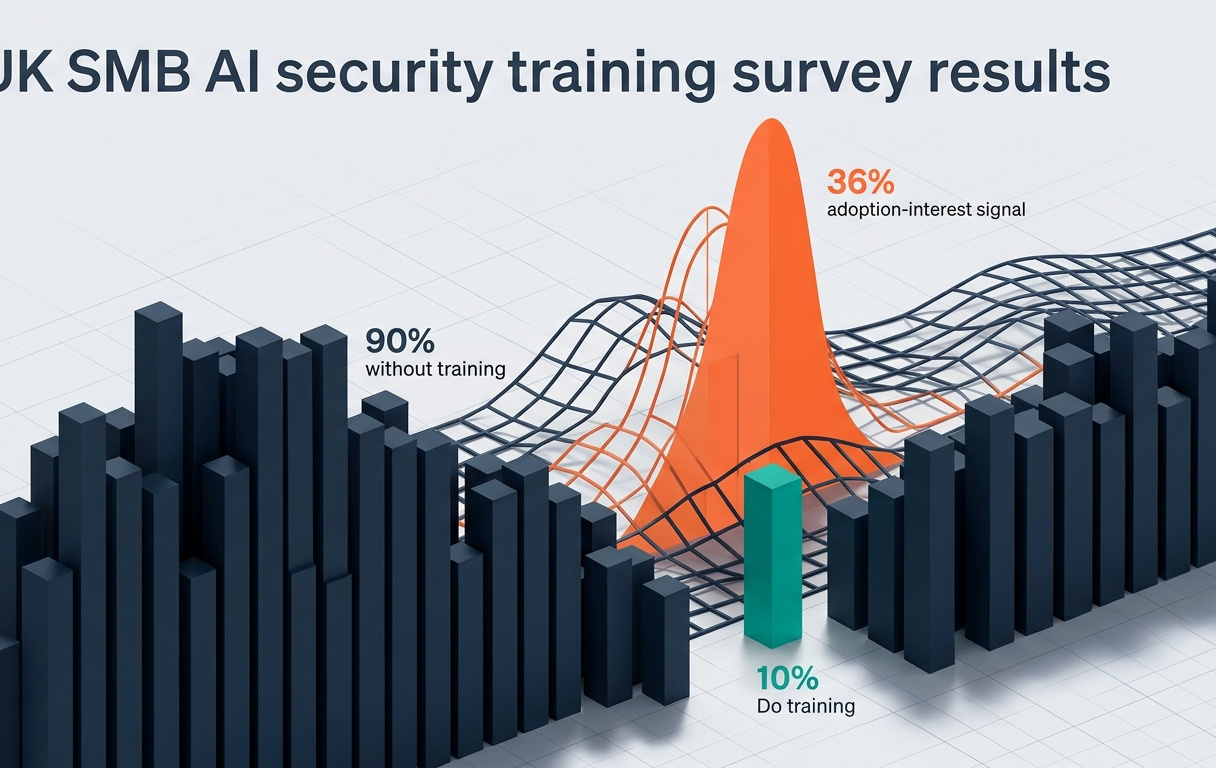
MoneySuperMarket survey of 250 UK SMBs reveals 44% worry AI exposes them to cyber threats but few invest in formal training; Scotland leads adoption.
Thales 2026 Bad Bot Report: AI-driven daily attacks jump from 2m to 25m. Bots now make up 53% of web traffic; bad bots 40%. UK ranks third for attack volume.
Richard Horne warns AI will expose weakly defended organisations faster; calls for rapid patching, exposure reduction and board-level ownership.
BoE Governor Andrew Bailey tells Columbia audience regulators must urgently understand whether Mythos can identify exploitable vulnerabilities in banking systems.
AISI's evaluation of Anthropic's Mythos finds it comparable to GPT-5.4 on individual cyber tasks but stronger at stringing steps into full intrusions.
UK AI Security Institute says Mythos Preview is the first model to finish its full cyber-range attack end-to-end, prompting a Bank of England CMorg briefing.
Anthropic has formed a coalition with AWS, Apple, Google, Microsoft and others to use its Claude Mythos model for defensive cybersecurity across critical infrastructure.
Anthropic restricts access to its Mythos cybersecurity model after it found thousands of vulnerabilities, including a 27-year-old OpenBSD flaw.
Royal Cornwall Hospitals NHS Trust has moved to Microsoft Sentinel to protect its 200+ sites and 15,000 users across Cornwall and the Isles of Scilly from growing cyber threats.
Interpol's latest threat assessment reveals that criminals using generative AI for fraud are dramatically more profitable, with agentic AI poised to enable fully autonomous scam campaigns.
A solo cybersecurity researcher used an AI agent to breach McKinsey's in-house AI platform Lilli within two hours, accessing 46.5 million chat messages.
Microsoft threat intelligence reveals North Korean state-backed groups using voice changers, face swap tools, and AI-generated CVs to infiltrate western companies.
Cybersecurity shares tumble — CrowdStrike down 8%, Okta 9.2% — after Anthropic launches a Claude-based vulnerability scanner, deepening AI disruption fears.
A bug in Microsoft 365 Copilot allowed the AI to summarise emails marked as confidential, bypassing data loss prevention policies.
SecurityScorecard found over 40,000 exposed OpenClaw instances, with 63% of deployments vulnerable and nearly 13,000 exploitable via remote code execution.
China's industry ministry alerts organisations that poorly configured OpenClaw deployments carry high security risks for cyberattacks and data leaks.
Banks deploy deep generative models to combat AI-powered fraud, reporting up to 90% reduction in false positives as fraud losses continue rising.
Joint SentinelOne and Censys research reveals thousands of open-source LLM deployments operating without guardrails, creating security risks for spam, phishing and disinformation.
LevelBlue reports 59% of organisations struggle to distinguish real from fake interactions as AI enables deepfake CEO fraud and dynamic attack vectors.
PwC survey of 3,887 executives across 72 countries reveals significant cyber preparedness gaps, with geopolitical uncertainty driving investment priorities whilst quantum readiness lags.