TL;DR
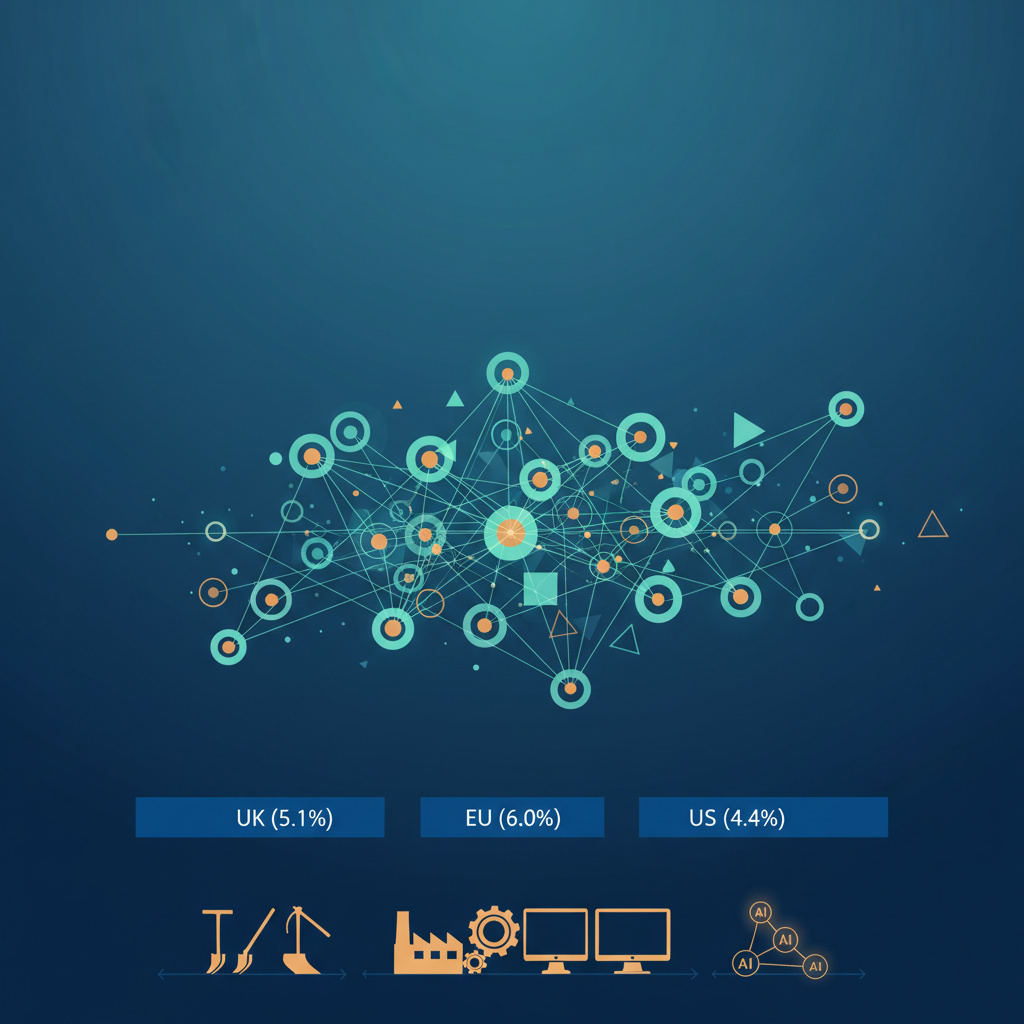
Despite widespread concerns about AI replacing jobs, unemployment in the UK (5.1%), EU (6%) and US (4.4%) remains at historic lows. While AI will eliminate some roles, history shows technological revolutions consistently create new types of work—though the benefits may not be equally distributed.
The Employment Paradox
ChatGPT is barely three years old, yet it has fundamentally changed how many people communicate and process information. This rapid adoption has fuelled serious concerns about mass unemployment as machines become better than humans at reading complex texts, translating languages, and presenting arguments.
Yet the employment numbers tell a different story. Unemployment in the EU stands at a historical low of around 6%—half the level of ten years ago. In the UK, it’s even lower at 5.1%, roughly matching the booming early 2000s.
Historical Precedent
Technology has always transformed rather than simply eliminated work. In 1800, around a third of British workers were farmers; today the proportion in agriculture is around 1%. This automation enabled Britain to lead the industrial revolution.
A more recent example proves instructive: when Barclays unveiled the world’s first ATM in London in 1967, fears arose that bank branch staff would disappear. The opposite occurred. Over the 30-year period of ATM growth in the US, the number of bank tellers actually increased by 10%. ATMs made it cheaper to open branches, extending financial services to more communities.
The Inequality Question
The critical question isn’t whether jobs will exist, but who will benefit from AI-enhanced productivity. Research has found that highly skilled entrepreneurs gain the most from AI support, contrary to initial hopes that AI assistants would reduce earning inequality.
Taking advice is itself a skill. Studies of chess players given top-quality AI advice showed it did little to close the gap between best and worst players—because lower-ability players were less likely to follow high-quality recommendations.
Looking Forward
The biggest risk AI brings may be that some people benefit far more than others. One group might use AI to manage everyday tasks whilst remaining stuck in low-productivity jobs. Another smaller, privileged group of well-educated workers could thrive by controlling the machines and the wealth they create.
Every technological revolution in history has made the world richer, healthier and more comfortable. But transitions are always hard. What matters next is how societies can help everyone become the boss of the machines—not their servants.