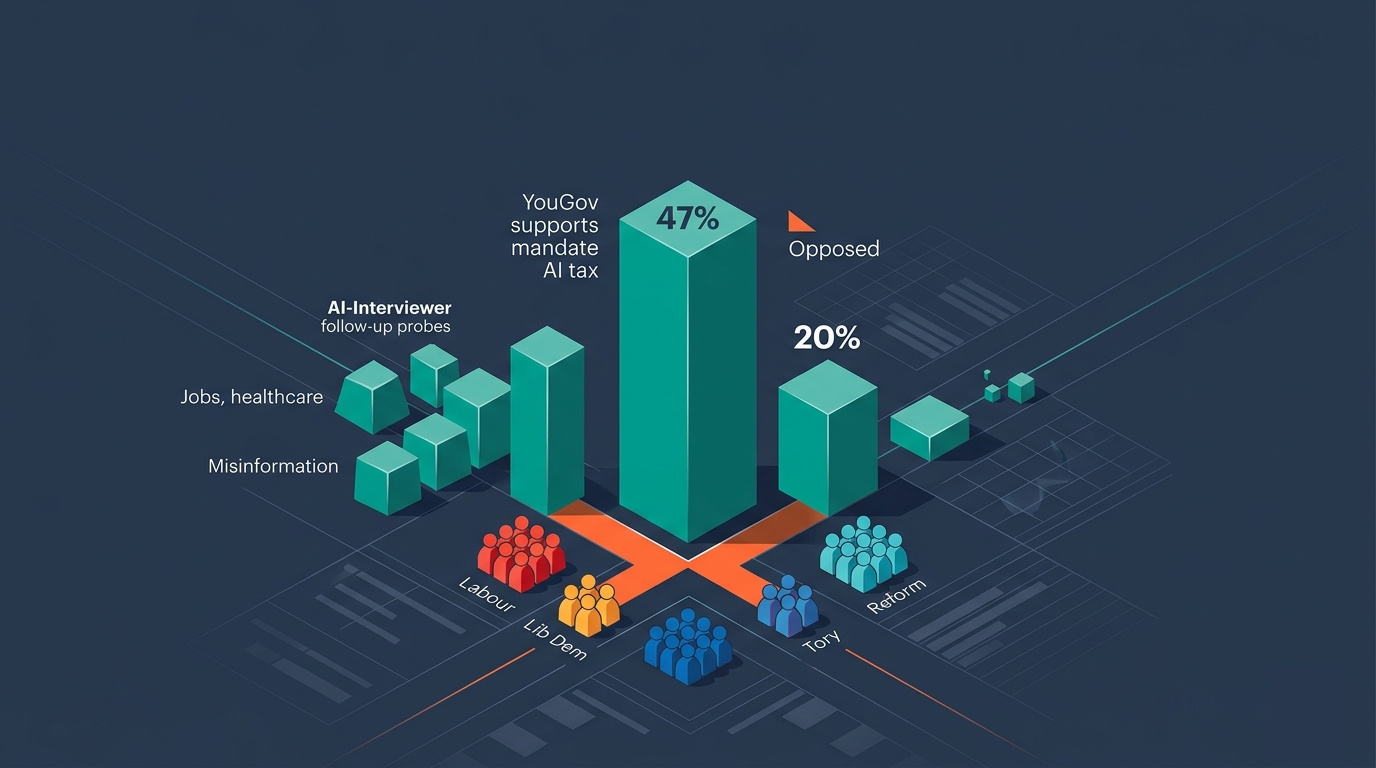
YouGov: 47% of Britons would back an AI tax, just 20% are opposed
TL;DR:
- New YouGov polling finds 47% of Britons support a tax on work conducted by AI rather than humans, with only 20% opposed; Labour, Lib Dem and Green voters run 55-58% in favour, Tories at 38% support, Reform UK voters split (34% support, 31% opposed).
- YouGov used its AI Interviewer tool to follow up with respondents qualitatively, surfacing concerns across jobs, misinformation and trust, healthcare, education, military use, the arts and environmental impact.
- Resultsense view: the polling is the strongest mandate signal for AI fiscal policy of 2026 so far — and arrives the same week Lord O’Donnell publicly argued AI productivity gains should fund mass retraining. The political case for an AI levy is no longer fringe.
The methodology is itself part of the story. After asking the headline AI-tax question, YouGov used its newly deployed AI Interviewer agent to conduct follow-up qualitative interviews with respondents, probing the “why” behind their answers. The technique allows quantitative scale with qualitative depth — and is itself a useful data point on AI-mediated social research.
What the support patterns show
The cross-party split is the most politically interesting finding. Labour, Lib Dem and Green voters back an AI tax 55-58% in favour. Tory voters net positive at 38% in favour against 27% opposed. Reform UK voters are the only group close to evenly split, at 34% in favour and 31% opposed. That distribution suggests an AI levy is a mainstream-coalition policy proposition rather than a left-flank one.
What people are worried about
YouGov’s qualitative analysis surfaces several themes. Employment and labour-market impact is dominant, with respondents anticipating reskilling pressures and uneven employer responses. Information integrity — misinformation, deepfakes, fraud — is a strong second concern. Healthcare comes up repeatedly: many respondents see scope for productivity in NHS administrative tasks and diagnostic screening, but flag the need for clinical oversight. Education emerges with worry about coursework integrity and student over-reliance. The arts, military use, and environmental impact each surface, with environmental concerns specifically flagging the energy and water demand of LLM-mediated search.
Demographic differences
Older respondents were more likely to cite healthcare and public services. Younger respondents foregrounded culture, creativity and the long-term cultural divide between those “consumed by AI content” and those who “manage to avoid it”. Women were more likely to raise education and social relationships; men were more likely to raise economic inequality and welfare consequences.
Cross-source context
The polling is a useful frame for several other UK developments this week. Lord O’Donnell told the FT that AI “winners” must be taxed to fund “losers” through retraining. Liz Kendall, the science secretary, framed AI investment as a national-sovereignty issue. The Ada Lovelace Institute, in its UN governance submission, cited its own UK polling showing 91% want AI to treat people fairly and 84% believe government prioritises tech companies over citizens. The picture is consistent: the UK public has both a strong appetite for AI capability and a strong appetite for redistribution and accountability around it.
Looking forward
For Treasury planners and political strategists, the YouGov data is a clean evidence base for any AI-related fiscal proposal. For business leaders, it is a leading indicator of the political environment in which AI deployment will be regulated, taxed and litigated through the rest of the parliament.