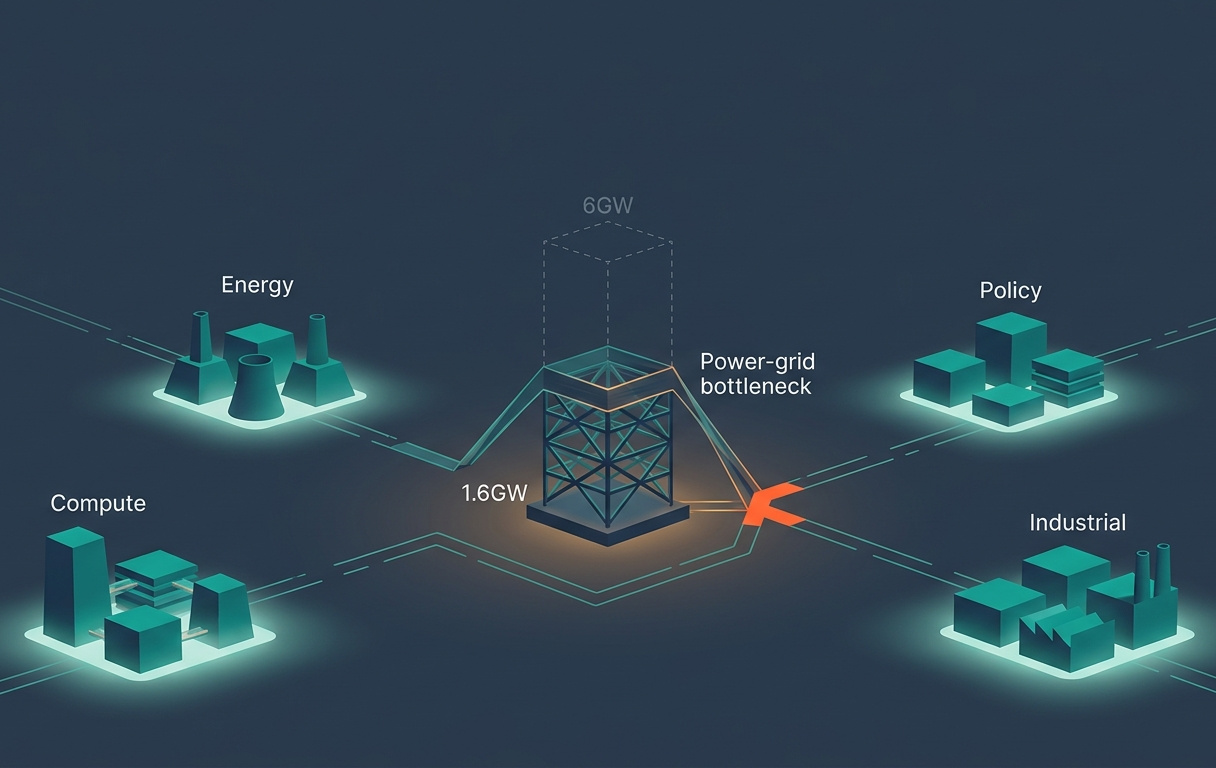
Rigby Group chief: UK AI strategy ‘disjointed’ as 1.6→6GW data centre target stalls
TL;DR:
- Rigby Group co-CEO Steve Rigby, writing in The Times, argues UK AI sovereignty is being treated as a departmental priority rather than a national strategy.
- Government’s announced ambition to scale UK data centre capacity from 1.6GW to 6GW is “constrained by power”, not demand or capital, requiring grid trade-offs ministers have so far avoided.
- Rigby cites the Joint Committee on the National Security Strategy’s recent finding of “no coherent plan” and calls for AI strategy to sit alongside energy sovereignty as the organising principle of policy.
Rigby — who chairs Family Business UK and runs one of the country’s largest privately held technology services groups — frames AI as a “transformational” capability that will “reshape economies, labour markets and national power”, and argues UK progress to date has been departmentally fragmented. He singles out AI minister Kanishka Narayan as a credible leader but says cross-party engagement and infrastructure commitment are missing.
Context
The data centre figures cited — current UK capacity of around 1.6GW scaling to 6GW under government targets — match the Department for Science, Innovation and Technology’s published trajectory. Industry analysts have repeatedly flagged grid connection queues and substation capacity in the South East as the binding constraint. National Grid ESO’s connection reform process is ongoing, and the AI Growth Zones policy launched in 2025 was designed to fast-track sites; Rigby’s argument is that the politics of choosing which projects to displace from the queue have not been faced.
His parallel argument on energy is that the UK approaches the topic “in silos”, citing North Sea production decisions made on net-zero rather than energy-sovereignty grounds. The piece links the two: AI compute requires reliable baseload, and the UK’s compute strategy is bottlenecked at the same point as its industrial electrification strategy.
For UK enterprise readers, the contribution sits alongside the Politico-reported criticism of the EU’s €20bn AI gigafactory plan as a “cathedrals in the desert” risk, and the Pentagon’s recent moves to broaden its AI vendor base. The shared theme: governments are committing AI infrastructure capital faster than they are resolving the power, policy and procurement constraints around it.
Looking forward
The Crime and Policing Bill, the consultation on facial recognition legislation, and the AI Growth Zones programme are all wending through 2026 in parallel. Rigby’s intervention is unusual in that it comes from a private-sector technology services CEO — Rigby Group’s revenue exceeds £4bn — rather than a think tank or trade body, lending it political weight. Whether the government responds with a published cross-departmental AI strategy, or continues to consult discretely through DSIT, will be the test of whether the criticism lands.