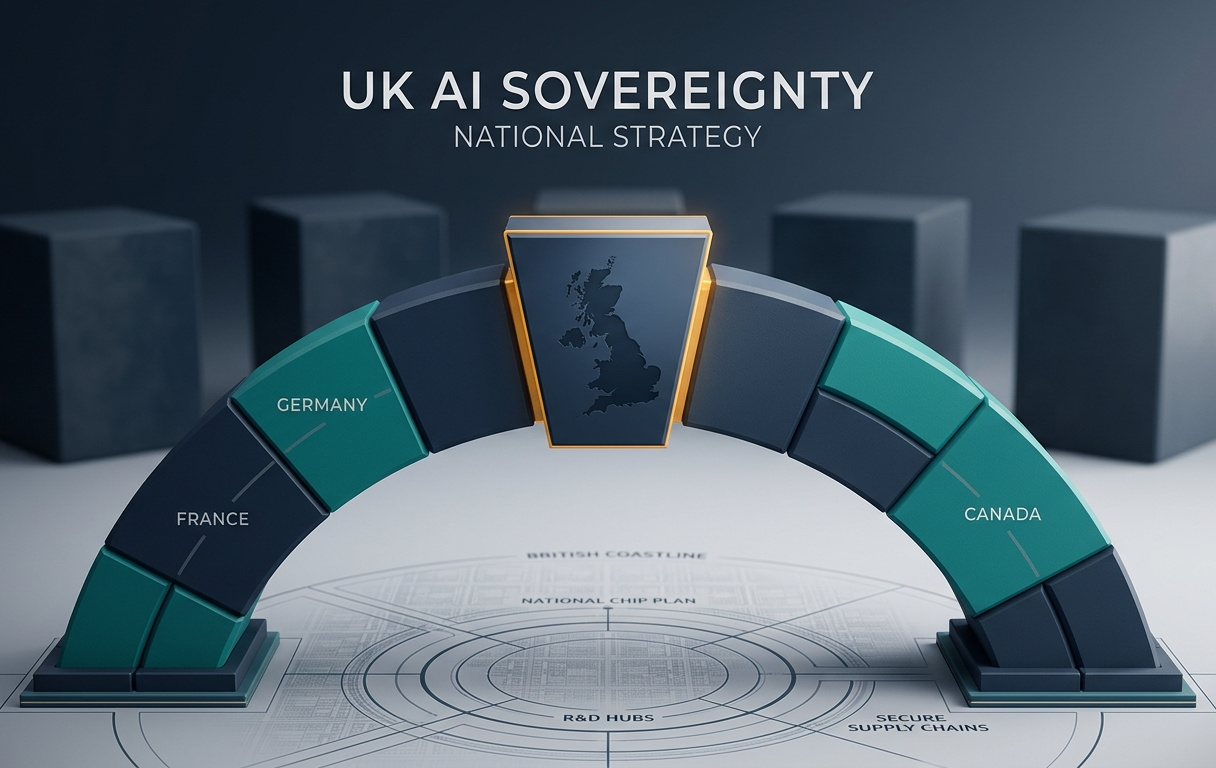
Kendall stakes UK AI sovereignty on chip plan and ‘middle powers’ bloc
TL;DR: Technology Secretary Liz Kendall told the Royal United Services Institute on Tuesday that Britain will draw up a national AI hardware plan covering chips and semiconductors, and pitch a “middle powers” alliance with France, Germany and Canada on AI security. Five US firms now control 70% of global AI compute, up from 60% a year ago. Kendall ruled out a development pause as a “double betrayal” of British talent.
Speaking at RUSI, Kendall framed AI sovereignty as a national-security imperative rather than an isolationist play. The argument: countries that fail to master each era’s defining technology — naval power, railways, electricity — cede control of their security and economic future. The currency now is chips, compute and AI itself.
What was actually announced
The concrete deliverables are narrower than the rhetoric. The hardware plan is yet to be written, with no timeline given. The “middle powers” pitch builds on AISI’s recent evaluation of Anthropic’s Claude Mythos model — a piece of work Kendall cited as evidence that the institute can punch above the UK’s compute weight. Best-practice guidance on model evaluation will be published in July at the next AI Security Institutes meeting.
Cross-source context matters here. The Guardian notes the speech lands in a difficult market: OpenAI has paused a multi-billion-pound UK datacentre, citing energy costs and regulation; former deputy PM Nick Clegg recently said the UK was without a “single steam engine” in the AI revolution; and a supercomputer scheduled to go live in 2026 is reportedly still a scaffolding yard in Essex. Reuters reports Kendall told reporters separately that other countries are “extremely interested” in working with AISI on model evaluation — the diplomatic backbone of the middle-powers framing.
Looking forward
For UK businesses, the practical reading is mixed. The state’s £500 million Sovereign AI Fund and a planned chips strategy signal demand-side support that VCs say grants alone cannot replicate. But supply-chain dependencies — China controls 98% of primary gallium and 83% of germanium, both critical chip inputs — and a thinly-staffed AI workforce remain unresolved. Kendall’s speech sets a direction; the substance arrives when the hardware plan is published.