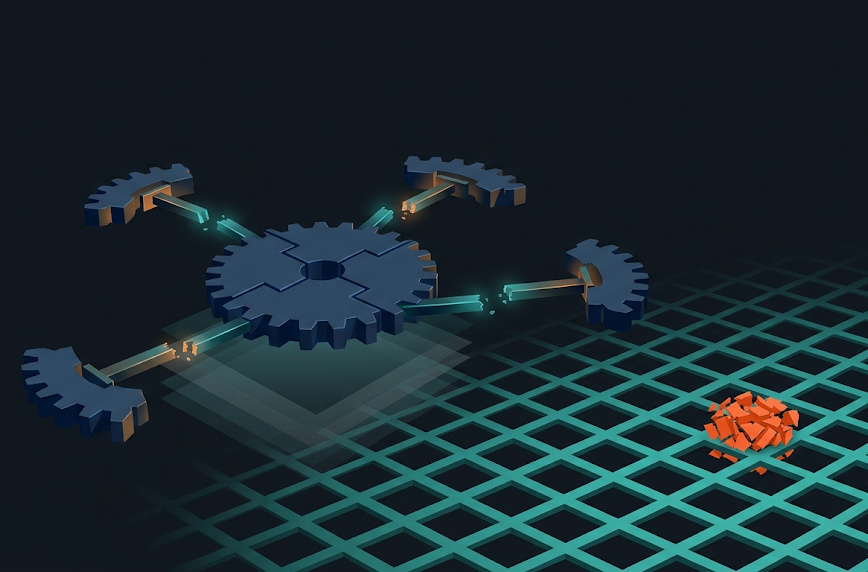
Britain’s new government has the diagnosis right. Its AI minister has publicly refused the optimism script, naming jobs as a material risk rather than an inevitable upside, and the prime minister has made technology policy a personal priority within a fortnight of taking office. What the government does not have is a department to deliver on any of it. DSIT was abolished ten days ago and its functions scattered across Whitehall; the replacement is a cabinet seat and a taskforce still assembling. In the gap between the diagnosis and the machinery, the obligation to retrain displaced workers has quietly defaulted to the employers doing the displacing — and most of them have not noticed they now hold it.
The problem hyphen names, and the one it doesn’t
Writing in hyphen, columnist Taj Ali builds the case for AI as a Burnham priority from a family history rather than a forecast. Ali’s grandfather worked the Vauxhall assembly line in Luton in the 1960s, when you could leave one factory and find six other openings in the same town on the same day. Ali’s father was among the 2,000 workers the same company made redundant in 2002. The van plant closed last year, ending 120 years of manufacturing in the town. Many of those laid off went into the taxi trade, and the taxi trade is now the sector governments are actively opening to autonomous operators.
That is the argument’s real force. It is not a claim that AI will destroy a fixed number of jobs. It is a claim about what happens to the landing places. Ali’s summary of the pattern is the sharpest line in the piece: “Almost every time people fall victim to automation and deindustrialisation, they end up taking jobs that are less skilled and more precarious, but readily available and that pay enough to get by on.” Britain has run this experiment before and knows the answer. Clacton and Blackpool; the ex-mining settlements of the Durham coalfield and the south Wales valleys. These are communities the article describes as having been “thrown on the scrapheap”, now carrying lower life expectancy, higher long-term illness and a receptive audience for the far right.
What the article does not address, because it was written as a challenge to the new government rather than an audit of it, is that Burnham has spent the first fortnight of the premiership removing the institutional capacity to act on exactly this. That gap is the subject worth analysing.
Critical Context: The machinery-of-government question and the AI-and-jobs question are usually treated as separate stories. They are the same story. A jobs-first AI policy is the most institutionally demanding variety of AI policy on offer — it requires labour-market surveillance, skills funding, regional delivery and regulatory teeth working in concert. It is the one you cannot run out of a small central unit.
The month in numbers
| Date | Event | What it does to delivery capacity |
|---|---|---|
| 20 July 2026 | Abolition plans leak; techUK and Startup Coalition object | Sector estimates a six-month reorganisation |
| 21 July 2026 | DSIT abolished; Narayan attends cabinet | AI Opportunities Action Plan, AISI, the £500m Sovereign AI Fund and UKRI split across departments |
| 27 July 2026 | Vallance to chair PM’s AI Taskforce | Authority recentralised in the Cabinet Office; AISI moves with it |
| 27 July 2026 | Narayan sets out the reindustrial plan | Priority given to chips and drones; jobs named as a risk, not a programme |
| 29 July 2026 | ONS adoption data published | Aggregate evidence points away from urgency |
Why the national statistics will keep saying everything is fine
Here is the awkward part for anyone arguing that AI displacement demands emergency treatment. The evidence does not currently support it. Office for National Statistics figures reported by CFOtech UK show AI adoption among UK businesses with ten or more employees rising from about 12% in late 2023 to 35%, with fewer than one in fifteen adopters reducing headcount as a result. Around half reported no difference to workforce size at all. More than 60% said they were building AI skills by training or retraining the staff they already had.
Read that alongside the IPPR modelling that anchors most UK coverage of the topic and the tension gets sharper. IPPR’s study covering 22,000 UK work tasks put 11% of them within reach of the generative AI that already exists, and 59% within reach once firms integrate the technology more deeply. Its worst-case scenario for that second wave carries 7.9 million job losses. Its central scenario carries 4.4 million alongside £144bn a year in GDP gains. Its best case carries none at all and £306bn. The 8 million figure that circulates as a headline is the tail, not the forecast — and the spread between the three is entirely a function of policy choices nobody has made yet.
So the aggregate says calm and the model says contingent. Both are defensible. Neither one touches Ali’s argument, because that argument was never about aggregates.
Strategic Insight: Luton’s manufacturing collapse never showed up as a national employment crisis either. UK employment rose across most of the period in which Vauxhall shed its workforce and George Kent and SKF closed. Aggregate labour-market statistics are structurally incapable of detecting geographically and occupationally concentrated harm. They are not the wrong numbers; they are numbers built to answer a different question.
We made a version of this case in June about why the macro payroll data is the last place an AI jobs crisis would appear. The place-based version is worse, because concentration compounds. When fewer than one in fifteen adopters nationally cut headcount, the national figure is a rounding error. When those same adopters happen to be the three largest employers in one town whose alternative employment is the sector next in line for automation, the local figure is a generational event. The ONS survey cannot see this. It is not designed to, and no reasonable redesign would make it.
Who is actually holding the obligation
Strip away the machinery question and ask a narrower one: today, on 31 July 2026, who is legally responsible for retraining a UK worker whose role has been automated?
Nobody. There is no statutory transition duty, no levy earmarked for AI displacement, no sectoral requirement to assess workforce impact before deployment. What exists is a patchwork of pilots operating two or three orders of magnitude below the scale of the problem being modelled. The government’s AI Upskilling Challenge Fund in Barnsley offers £800,000 across one South Yorkshire town, explicitly framed as a blueprint to learn from. In London, Sadiq Khan has committed £30m of City Hall money after a taskforce found roughly 600,000 Londoners in roles with high AI exposure and low capacity to adapt, disproportionately women in clerical work paying below the London average. Baroness Martha Lane-Fox, who chaired it, described the risk as “not a sudden shock, but a quieter drift — fewer entry-level roles, weaker career ladders and growing inequality.”
Both interventions are sensible. Neither is national policy, and one of them is being funded by a mayor asking Whitehall for devolved powers it has not yet agreed to give.
| Stakeholder | What they hold today | What they are exposed to |
|---|---|---|
| Central government | The diagnosis, a cabinet seat, a taskforce being stood up | Delivery capacity dispersed mid-reorganisation |
| Combined and city authorities | Local labour-market intelligence, modest budgets | Skills commissioning powers still reserved to the centre |
| Employers adopting AI | The automation decision and its timing | An unlegislated obligation that may become statutory |
| Trade unions | An agreed policy ask and no statutory hook | Consultation rights that predate the technology |
| Displaced workers | Statutory redundancy pay | No transition entitlement of any kind |
Reality Check: If you are a UK employer, the absence of a rule is not the absence of a risk. It means the rule has not been written yet, and you are currently generating the evidence base that will be used to write it.
What a jobs-first AI policy would have to contain
The TUC has set out the most complete version of the ask, in Building a pro-worker AI innovation strategy: a sectoral AI workforce strategy for each part of the industrial strategy, greater employer investment in training, and social security strong enough to carry people through job transitions without financial collapse. Ali’s minimum is narrower and blunter: the companies profiting from AI should fund the retraining or compensation owed to those it displaces, and the workers themselves should have a say in the legislation.
Neither is unreasonable, and the government has given no indication which parts it accepts. Three components would have to exist for any version of this to function:
Detection before disruption. London’s taskforce recommended an AI Early Action System to spot labour-market shifts before they become crises. That is the right instrument and it needs to be national, because the whole point is that national surveys will not fire in time. Detection has to be occupational and geographic, published at a granularity that lets a council see its own town.
A funding route proportionate to the modelling. £800,000 in Barnsley is a genuine experiment. It is also around 0.16% of the £500m Sovereign AI Fund, which itself is now split across departments. If the central IPPR scenario is anywhere near right, the transition budget and the compute budget should be visible in the same document.
A named owner with a delivery arm. The Vallance taskforce has the prime minister’s authority and sits alongside the Cabinet Secretary. What it does not have is the skills funding, the regional delivery machinery or the regulatory levers, all of which now sit in departments with other priorities. The government reached for the Vaccines Taskforce as its template. That unit had one objective and a hard deadline, which is precisely what a workforce transition programme lacks.
Warning ⚠️: The reorganisation is not neutral on this question. Skills sit with education, employment with work and pensions, industrial policy with the merged business department, AI capability with the Cabinet Office. A jobs-first AI strategy is the one strategy that requires all four to move together, and it is being attempted at the moment when they have just been pulled apart.
Priority actions for UK organisations
If you have deployed AI in a role-affecting way: document the workforce decisions you have already made — which roles changed, what redeployment or training was offered, what the alternatives considered were. You are building this record either way; build it deliberately.
If you are planning deployment in the next twelve months: assume a workforce-impact assessment becomes an expectation within this parliament, and run one now while it is cheap and voluntary. The TUC ask is the most likely shape of what lands.
If you employ at scale in a single locality: your local risk is not your national risk. Run the exposure analysis by site, not by headcount. Concentration is the whole mechanism.
Four things that will be harder than they look
The evidence gap is self-reinforcing. Aggregate data showing no crisis is being read as a reason to defer action. But the only policy that prevents concentrated harm has to be built before the harm is visible, and the data that would justify it arrives afterwards. Every month of reassuring statistics makes the case for pre-emptive spending politically weaker. Mitigation: argue from exposure, not from realised losses. Exposure is measurable now.
Retraining has a destination problem. Ali’s point about landing places is the one most often skipped. Retraining works when there is somewhere to land. Barnsley’s fund is aimed at manufacturing and logistics workers in a town whose alternatives are thin. Mitigation: pair any transition programme with a demand-side commitment, whether procurement, anchor-institution hiring or an employer guarantee. Skills without vacancies produce qualified unemployment.
Devolution is the unresolved variable. Khan is asking for skills commissioning powers and a share of savings from successful outcomes. Burnham, uniquely among prime ministers, spent nine years as a metro mayor making exactly that argument from the other side. Whether the centre concedes it now determines whether local intelligence connects to national funding. Mitigation: for businesses, engage the combined authority as well as Whitehall. That is where the practical schemes will originate first.
The entry-level channel closes quietly. The ONS data has one clear exception: employment of 22- to 25-year-olds in software development and customer service has been falling relative to older cohorts since late 2022. No redundancy programme, no announcement, no statistic that reads as a crisis. A cohort simply does not get hired. Mitigation: treat graduate and apprentice intake as a governance metric with board visibility, not a hiring-budget line that quietly flexes down.
The strategic takeaway
Ali’s article asks the government to make AI and jobs a priority. The government, on the available evidence, already believes it is one. Narayan has rejected “tech boosterism” and named the “material risks” AI carries for employment, for security and for the state itself, which is a considerably more honest starting position than the one it replaced. The problem is not the belief. It is that the belief has arrived at the same moment as a reorganisation that dispersed the capacity to act on it, and the two have not been reconciled in public.
For UK business leaders, three things follow.
The obligation is already yours, informally. No statute assigns responsibility for AI-displaced workers, so it sits by default with whoever made the automation decision. That is a commercial and reputational position long before it is a legal one.
The rules will be written from what you do now. Sectoral workforce strategies, if they come, will be built on observed employer behaviour during exactly this period. Organisations that can show deliberate transition practice will shape the standard; those that cannot will be regulated to it.
Your local exposure is the number that matters. National adoption figures will keep looking calm. Concentration is where the damage lands, and concentration is measurable at site level with data you already hold.
Take Action: Before the taskforce publishes anything, run three checks. Which of your sites has more than 15% of local headcount in high-exposure roles? What is your graduate and apprentice intake this year against the three-year average? And can you produce, on request, a record of what you offered the last cohort of people whose roles you automated? If any answer is uncomfortable, that is the work — and it is cheaper to do voluntarily than under a sectoral strategy.
Sources and further reading
This analysis responds to “Artificial intelligence needs to be one of Burnham’s biggest priorities” by Taj Ali, published by hyphen on 30 July 2026. The Luton and Vauxhall material is drawn from that article, which also draws on Sarah O’Connor’s We Are Not Machines and Elon Musk’s interview with The Economist.
Labour-market modelling is from IPPR’s AI exposure research. The policy ask is set out in the TUC’s Building a pro-worker AI innovation strategy. Adoption and headcount figures are ONS data reported by CFOtech UK, covered in our analysis of AI adoption without the expected job losses. Machinery-of-government detail comes from our coverage of the DSIT abolition and the Vallance taskforce. Warnings on middle-income displacement are from Simon Johnson’s intervention as chair of the AI Economics Institute.
Resultsense covers UK AI policy and its consequences for British organisations. If AI adoption is changing the shape of your workforce and you want a second read on the exposure, get in touch.