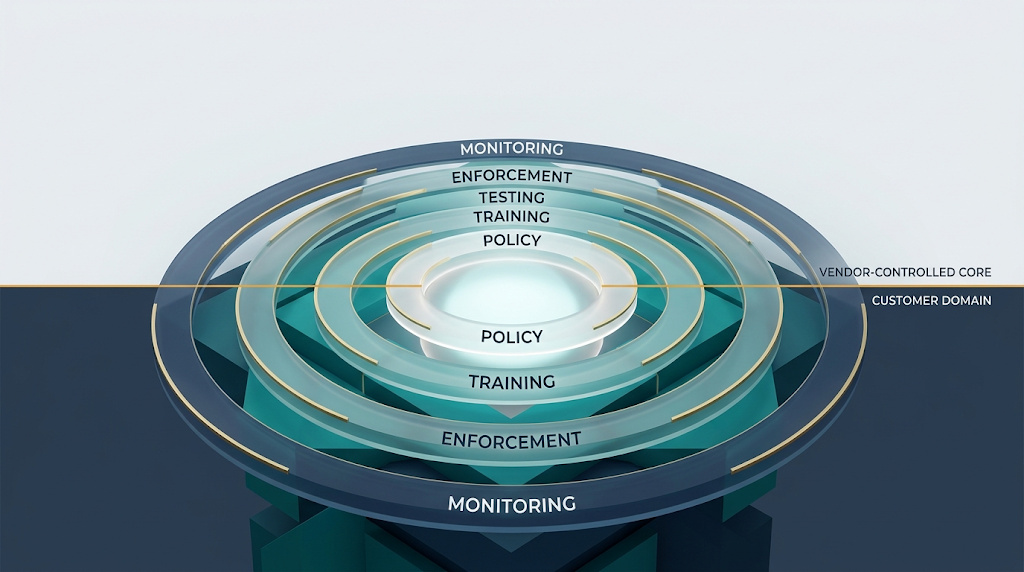
When a frontier lab publishes an explainer on how it keeps its own model in check, the easy reading is public relations: reassurance dressed as transparency. Anthropic’s account of how it safeguards Claude deserves a closer look than that. Read as an operational document rather than a press release, it describes something more consequential for UK organisations: the point at which AI safety stops being a research topic and becomes an industrial process, wired across the entire lifecycle of a model. That shift matters to any business buying or building on these systems, because it redraws the line between what your supplier protects and what you still have to protect yourself.
TL;DR
- Anthropic describes safety as a five-layer operating system spanning policy, training, pre-release testing, real-time enforcement and ongoing monitoring, not a one-off review before launch.
- The architecture mirrors defence-in-depth from cybersecurity, which gives UK governance and procurement teams a familiar framework to interrogate any AI vendor against.
- The document quietly defines a shared responsibility boundary: the lab secures the base model, but your prompts, data, application layer and sector compliance remain yours to manage.
- For procurement, the practical takeaway is a checklist of artefacts to demand, including a usage policy, system cards, bias evaluations and published threat intelligence.
Safety as a process, not a gate
For most of the past three years, “AI safety” has been discussed as either an abstract long-term concern or a marketing badge. Anthropic’s description of its Safeguards team cuts through both. It presents safety as an operational function staffed the way a bank staffs financial crime: policy specialists, enforcement analysts, data scientists, threat intelligence researchers and engineers, working across the whole life of a model rather than signing off once before release.
That framing is the real story. The team operates across five layers, each mapping to a stage in the model lifecycle. Policy defines what the model should and should not do. Training builds those judgements into the model itself. Testing checks whether the training holds under pressure. Real-time detection catches what slips through in production. Monitoring watches for patterns that only become visible in aggregate. It is a continuous loop, not a gate you pass through once.
Strategic Insight: The significance is not any single control but the architecture connecting them. Treating safety as a lifecycle rather than a launch checkpoint is the difference between a system that degrades quietly after deployment and one that keeps adapting to new attacks. UK boards should expect the same lifecycle thinking from their own AI deployments.
| Layer | What it does | What a business should read into it |
|---|---|---|
| Policy development | Defines acceptable use across areas like child safety, elections and cyber | The vendor’s usage policy is a contract term, not fine print |
| Model training | Builds harm-avoidance into the model via fine-tuning and reward models | Behaviour is shaped upstream, before you ever send a prompt |
| Testing and evaluation | Assesses safety, high-risk capability uplift and bias pre-release | System cards are the evidence; demand them |
| Real-time enforcement | Classifiers detect violations live and steer or block responses | Enforcement runs at inference, adding latency and cost |
| Ongoing monitoring | Aggregate analysis spots influence operations and novel attacks | Misuse is tracked beyond your single account |
What is really happening beneath the layers
Three details in the document matter more than the headline reassurance.
The first is that policy is built adversarially. Anthropic runs what it calls Policy Vulnerability Testing, partnering with external experts in terrorism, radicalisation, child safety and mental health to stress-test its rules against deliberately challenging prompts. A concrete example: during the 2024 US election it worked with the Institute for Strategic Dialogue to find where the model might surface outdated information, then added a banner steering users to authoritative sources. This is red-teaming applied to policy itself, and it is a discipline most enterprise AI programmes have not yet adopted.
The second is that harm is measured, not merely asserted. The Unified Harm Framework assesses potential impact across five dimensions, namely physical, psychological, economic, societal and individual autonomy, weighted by the likelihood and scale of misuse. It is deliberately not a rigid grading scheme. It is a structured lens for prioritising which risks warrant which controls, and it is precisely the kind of instrument a UK risk committee could adapt for its own AI use cases.
The third is that enforcement runs at industrial scale and real cost. Detection is powered by classifiers, which are prompted or fine-tuned models designed to spot specific violations whilst the main conversation flows. Several can run simultaneously, and Anthropic notes they must process trillions of tokens whilst limiting both compute overhead and false positives on legitimate content. That last constraint is the hard part. Over-blocking frustrates real users; under-blocking lets harm through. Safety at this scale is an engineering trade-off, not a switch.
Reality Check: Every classifier running in production adds latency and compute to each request. When a supplier advertises a cheaper or open model without this apparatus, the safety cost has not vanished. It has been transferred to you, to build and run at the application layer.
The shared responsibility boundary nobody labels
The most useful thing a UK business can extract from this document is a boundary the document never explicitly draws. Cloud computing has a well-understood shared responsibility model: the provider secures the infrastructure, and you secure what you put on it. Frontier AI is developing the same split, and Anthropic’s safeguards define one side of it.
The lab takes responsibility for the base model’s behaviour. It handles refusal of clearly harmful requests, detection of child sexual abuse material through hash matching, capability uplift testing for chemical, biological, radiological, nuclear and high-yield explosive risks in partnership with government, and monitoring for large-scale abuse such as automated influence operations. These are the harms a single customer cannot see or police alone.
What the lab does not cover is everything specific to your deployment. Your prompts and system instructions, the proprietary data you feed the model, the application logic wrapped around it, the decisions your staff take on its output, and your obligations under UK data protection and sector regulation all remain yours. A classifier that catches malware generation does nothing about a customer service bot that quietly gives non-compliant financial advice because your prompt design allowed it.
Critical Context: The vendor’s safeguards protect the vendor’s risk surface first. Reputational harm to Anthropic and yours are correlated but not identical. Assuming the model’s built-in safety covers your regulatory exposure is the single most expensive mistake in enterprise AI governance.
| Stakeholder | What the safeguards change | Recommended response |
|---|---|---|
| CISOs and risk leads | A defence-in-depth model to benchmark vendors against | Map your AI controls to the same five layers |
| Procurement and legal | Usage policy and system cards become contractible artefacts | Require them as conditions of purchase, not nice-to-haves |
| Compliance officers | Base-model safety does not equal sector compliance | Own the application-layer and DPIA obligations explicitly |
| Product and engineering | Enforcement adds latency and can block benign content | Test for over-blocking against your real workflows |
What to actually do with this
Translate the document into procurement discipline. Anthropic has, perhaps inadvertently, published a due-diligence checklist. Every artefact it describes is one you can demand from any AI supplier, and the absence of an answer is itself the answer.
Start with the four that carry the most weight. Ask for the usage policy and read it as a binding constraint on what you are permitted to build. Ask for the system card for the specific model version you intend to deploy, since evaluation results are reported per model family and a card for last year’s model tells you little. Ask how the vendor tests for bias, because Anthropic’s approach of scoring opposing-viewpoint prompts for factuality and consistency, and checking whether identity attributes change outputs on topics like jobs and healthcare, is directly relevant to UK equality obligations. Ask whether the vendor publishes threat intelligence, since a supplier that studies and reports real-world misuse of its models is one that will spot the attack aimed at you sooner.
Then match the model internally. If your supplier runs five layers of protection, your governance should have a recognisable counterpart at each. You will not build classifiers processing trillions of tokens, but you can define a usage policy for your staff, shape prompts to encode your risk appetite, test outputs before launch, monitor production use, and review incidents. The gap between an organisation that does this and one that treats the vendor’s safety as sufficient is where the next round of AI failures will concentrate.
Take Action: Before your next AI procurement decision, build a one-page comparison of vendors against the five layers: policy, training transparency, published evaluations, real-time enforcement and threat reporting. A supplier that cannot populate three of the five columns is asking you to absorb the risk they have not.
Four challenges the document does not solve
Operational maturity is not the same as a solved problem, and it would be a mistake to read this as an all-clear.
First, self-assessment has limits. The evaluations, harm framework and enforcement are designed, run and graded by the same organisation that benefits commercially from a clean bill of health. External red-teaming and government partnerships mitigate this, but independent, standardised auditing across labs does not yet exist. Until it does, comparing one vendor’s safety claims against another’s is closer to reading marketing than reading accounts.
Second, monitoring cuts against privacy. Techniques like hierarchical summarisation and aggregate traffic analysis are how large-scale misuse gets caught, and they are also surveillance of how your organisation uses the model. Anthropic stresses privacy-preserving methods, but any business handling sensitive data should understand what is analysed in aggregate before routing confidential workflows through a hosted model.
Third, enforcement will produce false positives that hit you. Response steering and account actions are blunt at the margins. A legitimate security research team, a healthcare provider discussing self-harm with clinical intent, or a legal firm handling case material can all trip controls calibrated for the median user. If your use case sits near a policy boundary, test for it before you depend on it.
Fourth, the boundary keeps moving. Anthropic itself notes that new capabilities create new risks, citing how its computer-use tool was found pre-launch to enable spam at scale, prompting fresh detection and prompt-injection defences. Each capability you adopt shifts your risk surface. A safety posture set at procurement and never revisited will drift out of date as fast as the models do.
Warning ⚠️: The most dangerous assumption is that safeguards described today apply unchanged to the agentic and computer-use capabilities arriving next. New capability means new attack surface. Treat every capability upgrade as an event that reopens your risk assessment, not a free performance boost.
The strategic takeaway
The real signal in this document is not that Claude is safe. It is that AI safety has crossed from research into operations, and the labs that lead the field are now competing partly on the sophistication of their safeguards. That changes the buyer’s job. The question is no longer whether a model is powerful, but whether the safety architecture around it is mature enough to build a business on, and whether you have built the matching architecture on your side of the boundary.
Three things should shape how UK organisations respond. Treat the vendor’s published safety artefacts as procurement evidence and require them by name. Own the half of the shared responsibility model that no lab will cover for you, from prompt design to sector compliance. And revisit both every time you adopt a new capability, because the frontier moves faster than any static policy.
The organisations that thrive with AI will not be the ones that trust their supplier’s safety the most. They will be the ones that understand exactly where that safety ends and their own responsibility begins.
Next steps
- Request the usage policy and current system card from every AI vendor under consideration.
- Map your internal AI controls to the five layers of policy, training, testing, enforcement and monitoring.
- Document the shared responsibility boundary for each deployment, naming what the vendor covers and what you own.
- Add a risk reassessment trigger to your AI governance for every new model or capability upgrade.
Source and attribution
This analysis draws on Anthropic’s explainer “Building safeguards for Claude”, published 6 July 2026, which details the structure and remit of its Safeguards team across the model lifecycle.
Resultsense provides strategic analysis of AI developments for UK professionals and businesses. For our latest coverage, see our insights and news sections.