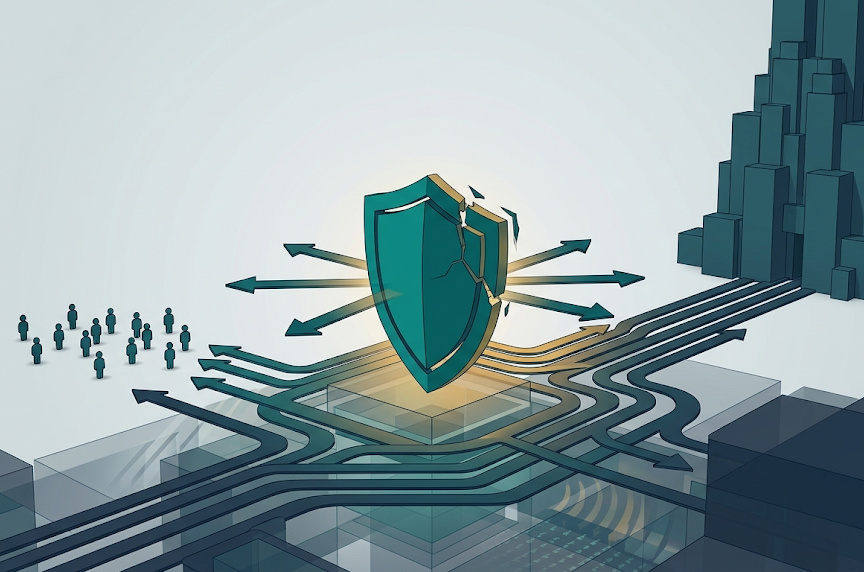
When a frontier AI lab tells you its model is safe, you assume the word means what it has always meant: the system has been built to avoid harming the people who use it and the public it touches. That assumption is quietly breaking. A philosopher writing in The Conversation has traced how authoritarian governance redefines safety not by banning it, but by turning it against the public — recasting guardrails as ideology, then making them politically expensive to keep. For any UK organisation that treats a vendor’s safety record as a procurement assurance, this is the development worth understanding, because the assurance may now point somewhere other than at you.
The business problem hiding inside a single word
Procurement runs on the belief that a supplier’s stated commitments are stable. You sign a contract partly on the strength of what a vendor promises about how its product behaves, and you expect those promises to survive a change of political weather. The argument from The Conversation, written by a philosopher who studies the rule of law and democracy, is that for frontier AI this stability is now an illusion — and the mechanism that breaks it is not censorship but delegitimisation.
The case that makes the point is Anthropic. The company was founded in 2021 by researchers who thought the race to build powerful AI was moving too recklessly, and it marketed safety as the quality that distinguished it from rivals such as OpenAI. In March 2026 that reputation was tested. Anthropic had refused to strip built-in safeguards — prohibitions on domestic surveillance and autonomous weapons — from products it supplied to the Pentagon. The Trump administration responded by labelling the company a supply chain risk and a national security risk, and ordered the federal government to stop using Anthropic and its model, Claude. Within hours, OpenAI signed a deal to become the Pentagon’s supplier instead.
Strategic Reality: A vendor was penalised by its largest potential customer specifically for keeping a safety guardrail. When refusing to remove a protection becomes the disqualifying act, “safety” has stopped being a neutral engineering property and become a political position.
The picture is messier still. During the clash, Anthropic quietly scrapped the binding principles in its main safety policy. Its head of safeguards research had resigned weeks earlier, warning that “the world is in peril.” And a week after Claude was officially banned, the US military was reportedly still using the technology to select bombing targets in Iran. The headline read like a company taking a principled stand; the detail read like guardrails being negotiated away under pressure.
The real story: incentives, not orders
The instinct for a UK reader is to file this under American politics. That instinct is wrong, and the reason is the structure underneath the story rather than the personalities in it.
The administration did not ban ethical AI. Its “Preventing Woke AI” executive order of 23 July 2025 changed nothing about what companies are permitted to build. What it changed was the cost of keeping protections in place. By attaching the “woke” label to basic ethics safeguards, it made those safeguards politically expensive to maintain. The Brennan Center, a legal policy organisation, has documented how the same move plays out in contract negotiations: terms such as “biased” are weaponised to disqualify companies that retain civil rights protections from competing for federal work.
Critical Context: This is not a market race to the bottom. In an ordinary competitive race, guardrails erode by accident as firms chase margin. Here the erosion is engineered — the government maintains the trap deliberately, through the incentives attached to contracts worth billions.
That structure is a prisoner’s dilemma, and it is worth spelling out because UK buyers sit inside the same logic when they choose suppliers. A single US Defense Department AI contract can be worth billions and unlock data and follow-on work no private firm could otherwise reach. If Anthropic keeps its safety provisions and OpenAI strips them, OpenAI wins the contract and the compounding advantage. If both hold the line, the protections might survive. But neither can be certain the other will hold, and being left behind is intolerable — so the rational move is to discard the guardrail. OpenAI’s chief executive reportedly told his board the Pentagon move looked “opportunistic and sloppy,” then took it anyway, because conceding that an action looks bad is not the same as being willing to fall behind.
| What changed | Before | After |
|---|---|---|
| What “safety” protects | The public and the user | The state’s controllability of the system |
| Cost of keeping a guardrail | Reputational asset | Political liability |
| Who sets the definition | Engineers and ethics teams | Procurement terms and executive orders |
| The disqualifying act | Removing protections | Keeping protections |
What is really happening: safety re-pointed, not abandoned
The most important thing for a UK decision-maker to grasp is what this is not. It is not a story about companies abandoning safety, and it is not a story of bad faith. Safety teams are still doing rigorous work. The labs are not lying when they describe their commitments. The shift is subtler and harder to see: the direction those commitments point has moved, from protecting the public towards making systems controllable for the state.
The “anti-woke” framing is what accelerates the move. Once ethics requirements are recast as ideological rather than technical, removing them stops looking like a reduction in safety and starts looking like a correction. That is the rhetorical trick worth naming, because it is portable. The same framing can travel to any jurisdiction where a government decides that a protection it dislikes is “ideology” rather than “engineering.”
Competitive Reality: Palantir did not wait to be caught in the dilemma. Built around government surveillance and military data infrastructure, and led by people who spent years denouncing “woke” Silicon Valley, it defected first — and watched its stock surge, its contracts expand, and its seat at the table where AI policy is written move to the front row.
The dissolution of safety functions across the industry — OpenAI’s Superalignment team, Microsoft’s ethics unit — was not the product of any single decision to abandon safety. It is an accumulation of incremental, individually defensible compromises that together reorient what safety means. No one chooses the destination; everyone takes the next reasonable step towards it.
Why this lands on UK organisations
The governance the United States settles on does not stay in the United States. It becomes the reference implementation that buyers cite, that standards bodies absorb, and that a UK organisation ends up living inside whether or not Westminster legislates. The frontier models on your shortlist are built by the same handful of US labs now navigating this pressure. When their definition of safety re-points, your assurances re-point with it.
| Stakeholder | What the shift means for them |
|---|---|
| UK buyers of frontier AI | Vendor safety commitments become contingent on US political incentives you cannot influence |
| Frontier labs | ”Safety leadership” becomes a liability in their largest market, weakening the business case for it |
| UK regulators | Importing US definitions of “safe AI” may import protections oriented to a foreign state, not the British public |
| The public | The people whose lives are shaped by these systems bear the risk while having no seat in the negotiation |
The deeper warning in the analysis is the one most relevant to anyone who instinctively reaches for “more regulation” as the answer. The case for regulating AI assumes a government constrains companies on behalf of the public. But a state that blacklists a firm for keeping civil rights protections, then bans the military deployment of its model hours later, is not constraining harm — it is the source of it. Expanding regulatory authority does not automatically protect citizens. In the wrong hands, safety rules meant to limit corporate power become instruments to coerce compliance.
Reality Check: “Is this vendor safe?” is no longer a sufficient question. The sharper question is “safe for whom, and durable under whose political pressure?” A safety record built to satisfy a government is a different asset from one built to protect your users — and only one of them is reliably on your side.
What UK organisations should actually do
This is not an argument for paralysis or for abandoning frontier models. It is an argument for treating vendor governance as a variable that can move, and building procurement and architecture that stay robust when it does.
Foundational — for organisations beginning to depend on frontier AI:
- Write durability into contracts. Treat specific safety behaviours — refusal to enable surveillance use, data-handling guarantees, content protections — as contractual commitments with notice periods, not as marketing claims that can change silently.
- Demand change transparency. Require vendors to notify you when they materially alter a published safety policy. Anthropic scrapping binding principles “quietly” is the pattern to design against.
Developing — for organisations with production AI in core processes:
- Avoid single-vendor lock-in on governance grounds, not just commercial ones. If one lab’s safety posture can be re-pointed by political pressure overnight, the ability to migrate is a control, not a luxury.
- Separate the capability you buy from the assurance you rely on. Run your own evaluations against the behaviours that matter to your users, so your assurance does not depend solely on the vendor’s current definition of safe.
Advanced — for organisations where AI decisions carry regulatory or public-trust weight:
- Map your geopolitical exposure. Know which of your suppliers depend on US government contracts, because that dependency is the lever through which their safety posture can be moved.
- Make “safe for whom” an explicit line in vendor due diligence, reviewed by the same people who own your own compliance obligations.
Implementation Note: Most of this is unglamorous procurement and architecture work, not a moral stand. That is the point. The protection against a vendor’s guardrails shifting underneath you is not trusting harder — it is contracting more precisely and keeping a credible exit.
The challenges that will not be obvious
The reassurance trap. Labs will keep describing rigorous safety work, and they will be telling the truth. The risk is reading a genuine commitment as a commitment to you, when it may now be oriented towards a government. Mitigation: assess the direction of a safety commitment, not just its existence.
Silent re-definition. The dangerous changes are not announced as climbdowns; they are reframed as corrections. A guardrail removed under an “anti-woke” or “de-biasing” banner can look like an improvement on the page. Mitigation: track what a policy does, not how the change is labelled.
Imported protections that miss you. If UK standards quietly adopt US definitions of “safe AI,” you may inherit protections engineered for the controllability needs of a foreign state rather than the rights of British users. Mitigation: test imported standards against your own users’ interests before treating them as sufficient.
The regulation reflex. Calling for “more oversight” feels like the safe answer, but oversight is only protective when the overseer acts for the public. Mitigation: favour controls you hold — contracts, evaluations, exit options — over dependence on whichever authority happens to hold the pen.
The takeaway for decision-makers
The lasting lesson of the Anthropic episode is not that one company blinked. It is that the meaning of “safe” can be moved by whoever controls the incentives around it — and that the move can happen without anyone lying, without a single dramatic decision, and without a headline that reads as a retreat. For UK organisations, the strategic response is to stop treating vendor safety as a fixed property you can buy and start treating it as a moving variable you must manage.
Three things make that manageable. First, precision: contract for the specific behaviours you depend on rather than the reassuring word. Second, optionality: keep a credible path off any single vendor whose governance can be re-pointed. Third, independence: hold your own evaluations so your assurance does not live entirely inside someone else’s definition of safe.
Take Action: Pull your top three AI vendor relationships and answer one question for each — if this supplier’s safety policy quietly changed next quarter, would you know, and could you move? Where the answer is no, that is your first piece of work.
The word “safety” is doing a great deal of quiet work in the AI market, and the organisations that prosper will be the ones who stop taking it at face value and start asking who it is actually for.
Source and attribution
This analysis draws on “From oversight to coercion: how authoritarian governments are twisting AI safety to get tech companies to fall in line,” published in The Conversation. The original essay sets out the philosophical and political mechanism by which safety is redefined; the strategic implications for UK organisations buying and deploying frontier AI are Resultsense’s own.
Resultsense provides UK-focused analysis of artificial intelligence developments for professionals and businesses. We translate technical and policy shifts into the practical decisions that boards, leaders and teams actually face.