Lord Darzi’s Telegraph op-ed this week reframes the UK’s AI strategy debate around a number Westminster has spent two years not really arguing about: kilowatt-hours. He argues Britain has the research, the companies and a unique NHS data platform, but is approaching a point where none of it will matter unless the grid is rebuilt and off-grid power for data centres is unblocked. For UK boards making procurement, infrastructure and sovereignty decisions over the next eighteen months, the practical version of that argument has already arrived.
The grid queue numbers tell the real story
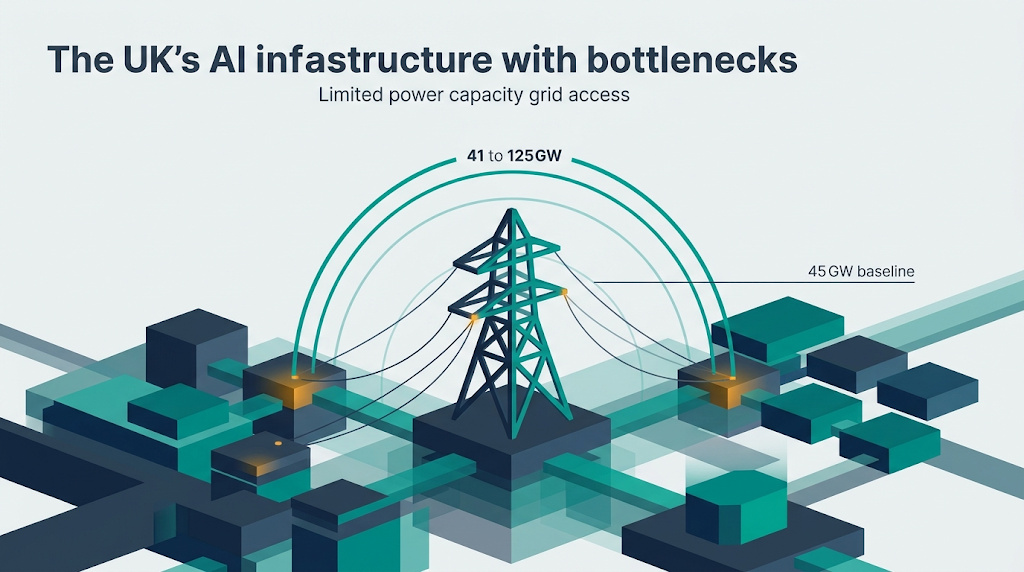
The headline data points in Darzi’s piece make the bottleneck concrete. UK data-centre electricity demand could grow more than fivefold by 2030, reaching nearly nine per cent of national consumption. The grid-connection queue jumped from 41 gigawatts in November 2024 to 125 gigawatts by June 2025 — almost triple the 45 gigawatts that Britain draws at peak winter demand. Around 140 data centres are queuing for connection. The queue is not just long; it mixes genuinely strategic AI projects with speculative applications that crowd out the ones that matter.
Strategic Reality: For UK enterprises planning AI-heavy workloads, the operative constraint is no longer “is there a UK data centre that suits us?” but “is there a UK data centre with a confirmed grid connection on a timeline that matches our roadmap?” That changes which suppliers, regions and contract terms are even available.
This is a different conversation from the AI sovereignty debate that has dominated 2026 so far. Liz Kendall’s middle-power coalition pitch a fortnight ago framed sovereignty as a procurement and vendor-diversification problem — which foreign technology stacks UK businesses are accepting leverage from. Darzi’s argument sits underneath that. Without domestic compute, the question of which foreign vendor to lean on is not really a choice — the only available answer is whoever has the power.
What’s actually happening in UK energy economics
Two structural facts shape the next decade of UK AI infrastructure economics. First, industrial electricity prices in Britain are four times higher than in the United States. Medium-sized UK businesses pay around 92 per cent more for electricity than the EU median. Second, the grid was built for a 45 gigawatt peak demand world; the AI workload pipeline alone is asking for 125 gigawatts of new connection capacity.
| Variable | UK position | Strategic implication |
|---|---|---|
| Industrial electricity price vs US | ~4x higher | UK loses on workload economics even where compute is technically equivalent |
| Medium-business electricity vs EU median | +92% | Hidden tax on every AI deployment cost case, not just data centres |
| Data-centre share of national power by 2030 | ~9% (5x growth) | Direct competition with reindustrialisation, electric heating, EV charging |
| Grid connection queue | 125 GW (vs 45 GW peak) | Queue contents, not queue size, will decide what actually gets built |
| NHS patient data scale | 67 million people | Strongest single applied-AI platform in any G7 economy |
The cost gap matters strategically because AI infrastructure is one of the few sectors that can relocate. A pharmaceutical plant or a financial-services operation has reasons to stay in the UK that exceed the electricity cost differential. A new training cluster or inference workload does not. Every percentage point of additional UK electricity premium is, in effect, a subsidy to overseas data centre operators competing for the same enterprise customers.
Hidden Cost: The electricity premium is not just a data-centre problem. It feeds through into the price of UK-hosted SaaS, UK-trained models and UK-served inference. Buyers comparing UK and Irish or French alternatives are seeing that gap before they know they are seeing it.
The NHS line in Darzi’s argument is the most concrete part of the strategic case. A single universal payer, 67 million linked records, and pilots already producing measurable results in imaging, triage and discharge planning. No comparable jurisdiction has the same combination of data scale, single-payer governance and direct ministerial accountability. That advantage is real — but it depends on the infrastructure to train, fine-tune and deploy models against that data inside UK jurisdiction. Move the compute offshore and the sovereignty argument collapses, regardless of where the data physically sits.
The two-track policy bet and what it asks of business
Darzi’s prescription is to run two infrastructure tracks at once. The first is conventional: rebuild transmission cables and substations, expand grid-scale storage, and reform the connection queue to prioritise strategically important projects over speculative ones. The second is unconventional and the harder political ask: remove regulatory barriers to off-grid power for data centres, including islanded gas generation where renewable capacity is not yet available on the necessary timeline.
Strategic Insight: The off-grid argument is not “build more gas plants for the climate’s sake.” It is “accept a transitional emissions cost on a defined set of AI infrastructure sites to avoid permanently exporting the workload — and the tax base — to jurisdictions that will burn the same gas anyway.”
For UK boards, the two tracks imply different planning horizons. Grid-track investments — new transmission lines, substation upgrades, queue reform — operate on five-to-ten year timescales and depend on cross-departmental delivery that is historically slow. Off-grid track decisions — islanded gas turbines on data-centre sites, behind-the-meter renewables, on-site storage — can move in eighteen-to-thirty-six months, but only if the regulatory permissions land. Boards betting on UK domestic compute over the next two years are betting on the second track delivering before the first.
What success looks like at the policy level
- The connection queue is triaged so that AI infrastructure projects with confirmed offtake are prioritised over speculative ones — Ofgem has begun this work but the political ceiling on which projects qualify is unsettled.
- Islanded gas, hybrid gas-and-renewable, and behind-the-meter solutions are permissible for strategically designated sites, with clear emissions accounting that treats them as transitional infrastructure rather than permanent carbon.
- The Sovereign AI Unit’s compute mandate moves beyond foundation-model funding to underwrite domestic data-centre capacity — particularly capacity tied to NHS, defence and critical-infrastructure workloads that cannot defensibly run offshore.
- Cross-departmental accountability sits with a named minister who can compel decisions across DESNZ, DSIT and the Treasury, rather than coordinating between them.
What it asks of UK enterprises
The stakeholder picture is broader than the data-centre industry. Every UK enterprise that has assumed domestic compute will be available for AI workloads at competitive prices is making a bet on this policy debate, whether they have priced it in or not.
| Stakeholder | What changes if Darzi’s argument lands | What changes if it does not |
|---|---|---|
| Hyperscaler UK regional operators | Permission to expand on-site generation; faster route to capacity | Capacity cap forces workload exports to Ireland, France, Nordics |
| NHS and public-sector AI buyers | Domestic compute remains available for sensitive workloads | Healthcare AI runs offshore by default, sovereignty case collapses |
| UK AI startups and scale-ups | Domestic inference economics improve, GPU access widens | Forced into foreign hyperscaler dependence at inflated rates |
| Energy-intensive manufacturing | AI investment crowds them out of grid queue | Data-centre demand pushes industrial reform onto the agenda |
| UK enterprise IT buyers | Domestic SaaS prices stabilise as compute supply grows | Persistent premium over EU peers, baked into every vendor quote |
| Treasury | New corporate tax base from domestic compute build-out | Lost revenue plus continuing infrastructure investment costs |
Competitive Reality: For UK enterprise buyers, the practical signal over the next six months is whether your shortlisted AI vendors can quote committed UK-region capacity on a sensible timeline. A widening gap between “available in the UK” and “available in EU” tells you the bottleneck Darzi describes is already shaping your procurement options.
The success criteria for boards are narrower than the policy debate. Can your AI workloads run in UK jurisdiction at competitive prices over a three-year horizon? If the answer is yes, your sovereignty position is strong. If the answer is “only if certain infrastructure decisions go a certain way,” that policy contingency is now a real risk on your AI roadmap, and worth surfacing to audit and risk committees rather than leaving inside IT.
Strategic recommendations by maturity stage
The right response depends on where an organisation sits in its AI adoption curve. Different maturity levels have different exposures to the energy bottleneck.
Early-stage adopters (proof-of-concept and small production workloads):
- Build vendor evaluations that explicitly request UK-region compute commitments with confirmed grid status, not just “available regions on a list”.
- Treat foreign-region pricing quotes as a separate scenario in business cases — the price gap is structural, not transient.
- Track the Sovereign AI Unit’s compute allocation announcements; early-stage UK ventures will be the first to feel either tailwind or shortfall.
Mid-stage adopters (multiple production workloads, growing inference spend):
- Audit which workloads have a real sovereignty requirement (NHS data, regulated finance, defence-adjacent) versus those that can defensibly run in any compliant jurisdiction.
- Negotiate multi-region failover into contracts, treating UK compute scarcity as an operational continuity risk rather than just a cost question.
- Build a board-level briefing that names the policy contingency: if grid reform and islanded power decisions go a particular way, what is the cost and operational impact?
Mature adopters (heavy training workloads, sovereign-sensitive deployments):
- Engage directly with the Sovereign AI Unit and DSIT on capacity prioritisation; mature buyers have leverage in the connection-queue reform debate that they tend not to use.
- Consider participation in industry coalitions pushing for islanded-power permissions, particularly where your workloads carry genuine national-security or public-service justification.
- Stress-test scenarios where UK domestic compute is unavailable: what is the actual fallback architecture, who controls it, and what does it mean for data-protection posture?
Implementation Note: The work to map your AI workloads against jurisdictional requirement is not glamorous, but it is the single most useful artefact a UK board can produce in 2026. It surfaces which sovereignty claims your organisation could actually defend and which are aspirations.
Hidden challenges that complicate the strategic case
Four issues sit beneath the surface of Darzi’s argument that will shape whether it lands in practice.
The connection queue is gameable. Reforming the queue to prioritise strategic projects sounds straightforward; defining “strategic” without inviting lobbying from every speculative applicant is harder. Ofgem’s early triage criteria have been criticised for opacity. UK boards relying on grid reform should not assume the criteria will favour them automatically, even where their workloads are clearly substantive.
Reality Check: A “strategic” definition that favours hyperscaler-affiliated projects could leave domestic UK AI ventures worse off than the unreformed queue. Whose definition wins is itself a lobbying outcome.
Islanded gas creates a climate-policy collision. The transitional-emissions argument is defensible economically but politically explosive. The Climate Change Committee’s next carbon budget is due in 2027, and AI-related emissions are likely to be a public-attention pressure point well before then. Boards making bets on off-grid power need to expect reputational scrutiny that the underlying economic case does not address.
Foreign hyperscaler retreat is a real downside scenario. AI sovereignty arguments can backfire if foreign hyperscalers conclude that UK political conditions are sufficiently unstable to deprioritise UK regional investment. The same logic that argues for domestic compute can, badly executed, accelerate the loss of foreign-funded capacity that currently dominates UK supply. The middle-power coalition argument from Kendall and the energy-infrastructure argument from Darzi need to align practically, not just rhetorically.
The skills bottleneck affects both ends. The shortage of trained AI engineers is well-documented. The shortage of grid engineers, substation electricians and transmission planners is less discussed but binding on the same timeline. Investing in compute capacity without parallel investment in the human infrastructure to build and run the grid that powers it produces a delivery gap that money alone cannot close.
Critical Context: A national skills strategy that treats AI engineers and grid engineers as related challenges, not separate ones, would mark a genuine shift in how UK industrial policy thinks about AI. The current pattern is to fund them through different departments on different timelines.
The strategic takeaway for UK boards
Darzi’s argument is, at its core, that UK AI competitiveness now depends on three intertwined assets — energy, compute and data — and that the energy leg has been treated as a background utility while the compute and data legs have absorbed the strategic attention. For UK enterprises, the practical translation is that AI roadmaps built on the assumption of available domestic infrastructure are carrying a policy risk that has not yet been priced.
Three success factors define a defensible UK AI infrastructure position over the next three years.
- Jurisdictional clarity. Know which of your AI workloads genuinely require UK compute and which do not — and make sure that distinction is documented at the procurement and risk-committee level, not assumed in vendor slide decks.
- Policy contingency. Treat grid reform and islanded-power decisions as named risk variables in your AI strategy, with assigned owners and quarterly review. The decisions will be made in the next twelve to twenty-four months; the consequences will run for a decade.
- Coalition participation. UK enterprises with real AI exposure have more leverage in the connection-queue and off-grid debates than they typically exercise. Industry coalitions, trade-association responses to Ofgem consultations, and direct engagement with the Sovereign AI Unit are the channels where the operational definition of “strategic project” actually gets decided.
Take Action: The single most useful audit a UK board can run in the next quarter is a workload-by-workload review of where their AI is running, where it would run in a UK-capacity-constrained scenario, and what the cost and risk gap looks like. The output of that audit, more than any vendor briefing, will tell you how exposed your organisation is to the bottleneck Darzi describes.
The argument Darzi makes is unusual for a policy op-ed because it asks ministers to treat power as a first-class strategic asset rather than a utility managed at arm’s length. UK boards making AI decisions have a parallel reframing to do internally — treating compute access not as an IT procurement question but as an infrastructure dependency with policy contingency attached. The work to make that shift is not technical. It is governance, and it belongs at board level.
Source
Darzi, A. (2026, May 13). Britain will lose the AI race without more energy. The Telegraph.
Analysis by Resultsense. Lord Darzi is Executive Chair of the Fleming Initiative and Co-Director of the Institute of Global Health Innovation at Imperial College London, and former Parliamentary Under Secretary of State in the Department of Health.