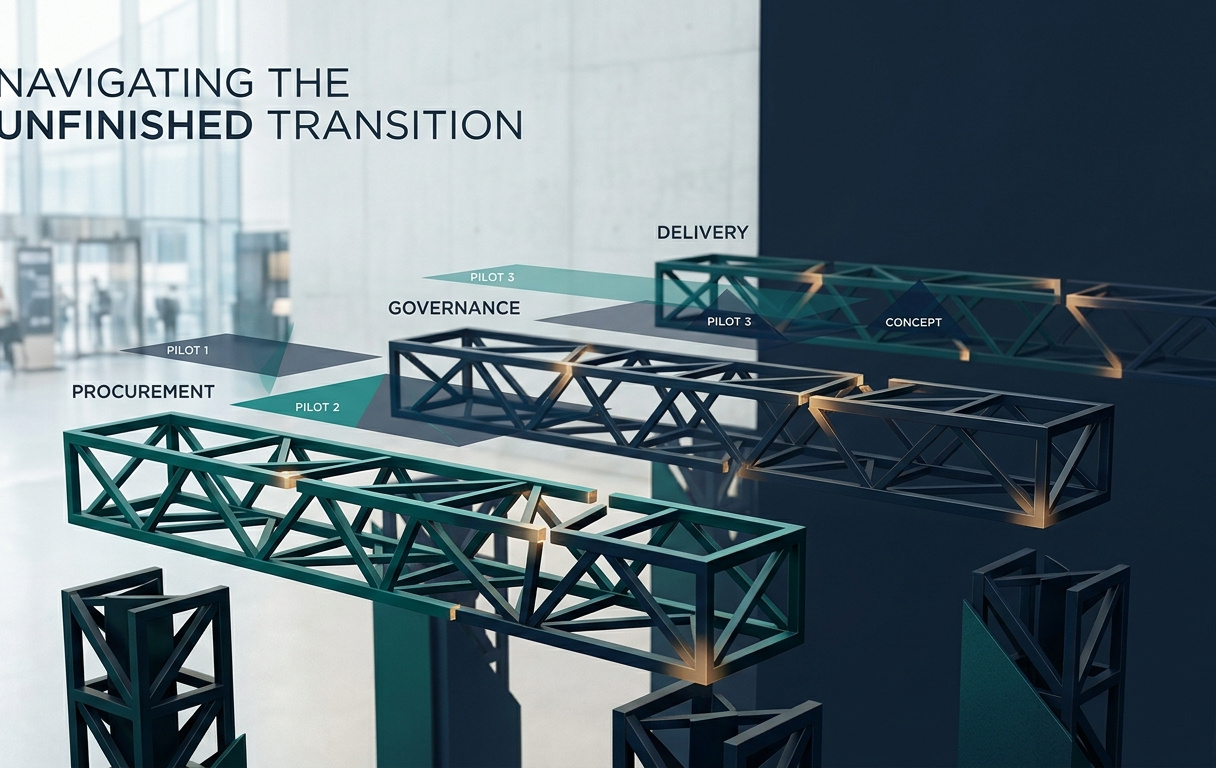
A year on from the AI Opportunities Action Plan, the practitioner consensus is that UK government AI projects are still stuck in pilot. THINK Digital Partners’ coverage this week of Denodo’s analysis lands on a familiar diagnosis: trust is the obstacle, fragmented data is the underlying problem, and a different architectural approach to data access is the answer. That reading is correct as far as it goes, but it is not the most useful frame for UK leaders trying to move beyond proof-of-concept. Trust and data fragmentation are downstream symptoms. The reasons UK public-sector AI projects stall sit in three interlocking gaps — procurement, governance, and delivery — and each one fails differently.
What the practitioner consensus is missing
The data-quality argument is real. Departmental record systems were built across decades, by different suppliers, under different policy regimes. HMRC, DWP, the NHS, and the Home Office each operate data estates that were not designed to interoperate, and the trust questions Errol Rodericks describes — sovereignty, traceability, auditability, data sharing — are genuine constraints on responsible deployment. Resolving them is necessary work.
But the data narrative has become a comfortable resting place for the debate. It allows everyone in the room to agree on the problem without confronting why three years of investment in data platforms, master data management, and federated query architectures have not yet produced a wave of operational AI in UK government. The answer is that data quality is rarely the binding constraint on a stalled project. The binding constraints are how the project was bought, who is accountable for it, and whether anyone is empowered to take it from pilot to production.
Strategic Reality: Departments that have solved the data-access problem — DWP and HMRC have made meaningful progress on federated query — still have AI initiatives stuck in pilot. Data is necessary but not sufficient. The gap between proof-of-concept and operational deployment is structural, not technical.
The procurement gap
UK public-sector AI is bought through frameworks that were designed for stable, definable IT goods and services. The Crown Commercial Service’s main routes — G-Cloud 14, the Digital Outcomes and Specialists framework, the new AI Dynamic Purchasing System launched in late 2025 — assume a buyer who can specify outcomes in advance and a supplier whose capability stays roughly constant across the contract life. Frontier AI does not behave that way. Model capability shifts every six to nine months; cost-per-token has fallen by an order of magnitude in some categories since the original specifications were written; and the supplier base consolidated rapidly through 2025.
The result is a procurement environment that produces three predictable failure modes:
| Failure mode | What it looks like | Where it shows up |
|---|---|---|
| Locked-in pilot | Original supplier wins on a 12-month task and becomes the only practical route to scale | Departmental productivity tools, document-processing pilots |
| Specification drift | RFP written against capability the model did not yet have; project re-scopes mid-flight | Citizen-facing chat agents, case-handling automations |
| Capability arbitrage | Two suppliers bidding the same outcome with different model generations, evaluated as if equivalent | Fraud and anomaly detection, eligibility scoring |
| SME exclusion | Frameworks favour suppliers with existing public-sector pre-qualification; smaller AI specialists priced out | Local government procurements, ALB pilots |
The Procurement Act 2023, in force since February 2025, was meant to address some of this through more flexible competitive procedures and clearer routes for SMEs. Early evidence is mixed. The Act gives buyers more tools, but it does not change the underlying scarcity of public-sector commercial officers with deep AI literacy. A buyer who cannot evaluate whether one model’s reasoning chain is materially better than another’s for fraud detection will default to non-functional criteria — track record, security clearances, framework membership — and the larger incumbent suppliers will keep winning.
Hidden Cost: The most expensive line in a stalled UK government AI project is rarely the licence. It is the months of departmental staff time spent re-running procurement after the first contract proves unfit for the operational stage. Two abortive procurements can consume more than a year of an SRO’s tenure.
The governance gap
UK government has built more AI governance machinery in the last 18 months than any peer country. The Algorithmic Transparency Recording Standard (ATRS) became mandatory for central government in February 2024. The AI Security Institute has scaled to 70-plus researchers. The Government Digital Service was reconstituted in late 2024 to consolidate AI capability inside Cabinet Office. The AI Opportunities Action Plan named a delivery unit and assigned departmental responsibilities. On paper, the governance ecosystem is rich.
In practice, the gap between governance scaffolding and project-level discipline remains wide. ATRS publication has trickled rather than scaled — the public register still shows fewer than 60 records 18 months after mandatory uptake — and most of those records cover deployed systems rather than the much larger population of pilots and proofs-of-concept where governance discipline most needs to be set. AISI’s remit covers frontier model evaluations, not departmental deployments. GDS’s central role on AI within Cabinet Office is real but under-resourced relative to the volume of departmental requests.
The practical consequence is that individual SROs are left to construct their own governance frame for each project. They draw on the AI Playbook, the Generative AI Framework, departmental ethics committees, and informal peer networks; the artefacts they produce are inconsistent across departments and rarely survive their author’s tenure. A new SRO arriving 18 months in inherits a governance position they did not write and may not be able to defend if the project comes under scrutiny.
Critical Context: The biggest cause of governance failure in UK government AI is not a missing standard. It is SRO turnover. Major Projects Portfolio data shows median tenure on digital programmes well under three years; AI projects often outlast the official who signed off the original ethics review.
The delivery gap
The third gap is the hardest to fix because it is the most cultural. UK government has historically delivered digital change through one of two playbooks: the GDS service-design model (user-led, iterative, agile) or the Major Projects Authority model (gateway reviews, business cases, Treasury Green Book five-case template). Both work for their respective use cases. Neither is a clean fit for AI deployment.
The GDS model assumes that user needs are stable enough for sprint-paced iteration to converge on the right service. Generative AI features change what is possible inside a sprint; teams that started building one capability find themselves shipping something architecturally different by month three. The Major Projects model assumes a capital-investment shape — large upfront commitment, defined deliverables, structured benefits realisation. AI deployment is closer to operational expenditure with continuous capability refresh; the Green Book benefit-cost ratio framework struggles with capabilities that improve under the project rather than being delivered by it.
Departments have been trying to bridge the two playbooks rather than choose. The result is delivery teams that adopt agile practices but report against waterfall milestones; AI initiatives that are scoped as products but funded as projects; and a tendency to declare success at the pilot stage because the structures available to take it further were built for a different shape of work.
Implementation Note: The most successful UK government AI deployments of the last 24 months — the Cabinet Office’s Humphrey suite, HMRC’s compliance triage, DWP’s anomaly detection — share a structural feature. Each was protected from the standard departmental delivery cadence by sitting inside a unit with a different funding model and a longer accountability horizon. Departments that lack that structural protection are unlikely to replicate the result through better project management alone.
What different parts of the public sector should do this quarter
The right action depends on which gap is binding for your organisation. The maturity ladder below is descriptive, not prescriptive — most central departments will recognise themselves as straddling stages.
For organisations early in operational AI — typically those with two or three live pilots and no production deployment — the priority is procurement clarity. Audit your current AI contracts against the four failure modes in the procurement table above. Identify which of your pilots have the structural shape to scale (continuous capability refresh, clear in-house ownership of evaluation criteria) and which are locked-in by design. The work is uncomfortable because it surfaces sunk-cost decisions, but it is the precondition for any further investment.
For organisations with established AI governance — board-equivalent oversight, an AI risk register, a named SRO community — the priority is governance continuity. Build governance artefacts that survive SRO turnover. That means standardising the ATRS record, the data-protection impact assessment, the equality impact assessment, and the model evaluation report into a single project dossier maintained by the team rather than by the individual official. Departments that have done this report meaningfully shorter ramp-up times when leadership changes.
For organisations operating at frontier maturity — typically central departments with multiple production AI systems, sovereign cloud arrangements, and direct relationships with model providers — the priority is delivery model design. Stop trying to bridge GDS and Major Projects playbooks and pick a third route: an internal product-and-platform team funded as a continuous capability rather than as a programme. The Cabinet Office Digital and Data team, GDS’s AI engineering function, and HMRC’s Risk and Intelligence Service offer different versions of this model. The departments that will scale AI fastest are the ones that put the cost of running an AI capability on a baseline rather than treating each deployment as a discrete project.
Resource Reality: A small in-house product team with a continuous funding line will out-deliver a large external supplier on a fixed-term contract, in nearly every case observed across UK government in the last two years. The cost difference is real but smaller than departments assume — and the through-life total cost is usually lower for the in-house route.
Hidden challenges most public-sector leaders will miss
Four non-obvious challenges sit underneath this question. None of them resolve through the standard responses.
The first is the cross-departmental data-sharing residue. Despite the legal frameworks introduced through the Data (Use and Access) Act 2025, cross-departmental data sharing in practice still depends on a patchwork of memoranda of understanding, sector-specific gateways, and bilateral agreements that pre-date the Act. AI use cases that depend on linking data across two or more departments — fraud, vulnerability identification, eligibility — encounter friction the headline policy does not anticipate. Mitigation is bureaucratic and slow; it is also unavoidable for the highest-value use cases.
The second is the IR35 talent hangover. Public-sector AI projects rely heavily on contractor capacity for senior engineering and machine learning expertise. The 2017 and 2021 IR35 reforms reduced the pool of contractors willing to take on inside-IR35 government engagements; the resulting reliance on consultancy-supplied talent introduced a layer of margin and a churn cycle that AI delivery is particularly sensitive to. There is no quick fix. Departments that have built genuine in-house capability — typically through Civil Service Fast Stream digital pathways or apprenticeship routes — are pulling ahead.
The third is the audit-and-evaluation deficit. The National Audit Office’s December 2024 report on AI use in government found that fewer than half of departmental AI deployments had a documented post-implementation evaluation. The evaluation gap matters not because it embarrasses ministers but because it removes the feedback loop that would let departments distinguish what is working from what looks like it is. Mitigation is about cadence: every AI deployment needs a 90-day, 180-day, and 365-day evaluation in the project plan from the outset, not as an afterthought.
The fourth is public legitimacy after Horizon. The Post Office Horizon scandal cast a long shadow over the trustworthiness of algorithmic decision-making in UK government. The shadow is asymmetric — a single visible failure now triggers political and media scrutiny that no number of successful deployments will offset. Mitigation is about expectation management at programme initiation: the political risk of an AI system going wrong is materially higher than the political reward of one going right, and departmental leadership needs to acknowledge that explicitly when sponsoring projects.
Reality Check: The data-fragmentation framing is comfortable because it suggests an architectural fix. The procurement, governance, and delivery framing is uncomfortable because it points at how government works. That discomfort is the signal: the problems that have not been solved in three years of investment are unlikely to be solved by another data platform.
Strategic takeaway for UK public-sector leaders
THINK Digital Partners is right that UK public-sector AI initiatives are stuck in experimentation rather than producing measurable outcomes. The diagnosis offered — trust deficit and fragmented data — captures what practitioners feel but not what is causing the stall. The procurement, governance, and delivery gaps described above are the structural reasons projects do not move from pilot to production, and each requires a different intervention.
Three success factors for UK public-sector organisations from here:
- Choose your binding constraint and address it first. Most organisations have all three gaps to some degree, but only one is the immediate blocker for your specific portfolio. Procurement audit, governance continuity, or delivery-model redesign are different programmes with different costs and different sponsors. Conflating them is the most common mistake.
- Build for SRO transition, not for SRO authorship. Governance artefacts, evaluation cadence, and supplier relationships should outlast the official who set them up. If your AI programme depends on a named individual remaining in post, it is one personnel decision away from stalling regardless of the technical work.
- Treat AI capability as a baseline cost, not a project cost. The departments delivering operational AI consistently are the ones funding their AI capability as a continuous baseline of in-house and partner capacity, with project-shaped budgets sitting on top. Reversing that — funding everything as a project — is the structural cause of the pilot trap.
Take Action: This quarter, commission a single-page diagnostic for your senior team mapping each live AI initiative against the procurement, governance, and delivery dimensions. The exercise takes a fortnight, the output is durable, and it gives the accounting officer something concrete to defend at the next departmental review.
The AI Opportunities Action Plan set a credible direction. The reasons UK government AI projects keep stalling are not in the plan; they are in the operating model that has to deliver it. Public-sector leaders who treat the operating model as a given will keep producing pilots. The ones who treat it as the actual variable have a chance of producing services.
Source citation and attribution
This analysis builds on THINK Digital Partners’ coverage “Why UK government AI projects stall — and what public sector leaders need to do next” (29 April 2026), featuring Errol Rodericks of Denodo, supplemented by reference to the AI Opportunities Action Plan, the Algorithmic Transparency Recording Standard public register, the Procurement Act 2023, the Data (Use and Access) Act 2025, the National Audit Office’s December 2024 report on AI use in government, and HM Treasury Green Book guidance.
Resultsense provides UK-focused analysis of AI strategy, governance, and commercial implications for business leaders. For further analysis of UK AI policy and public-sector implementation, see our insights archive and the related coverage of AISI’s red-team findings and UK enterprise implications and the governance posture for frontier AI in UK boards.