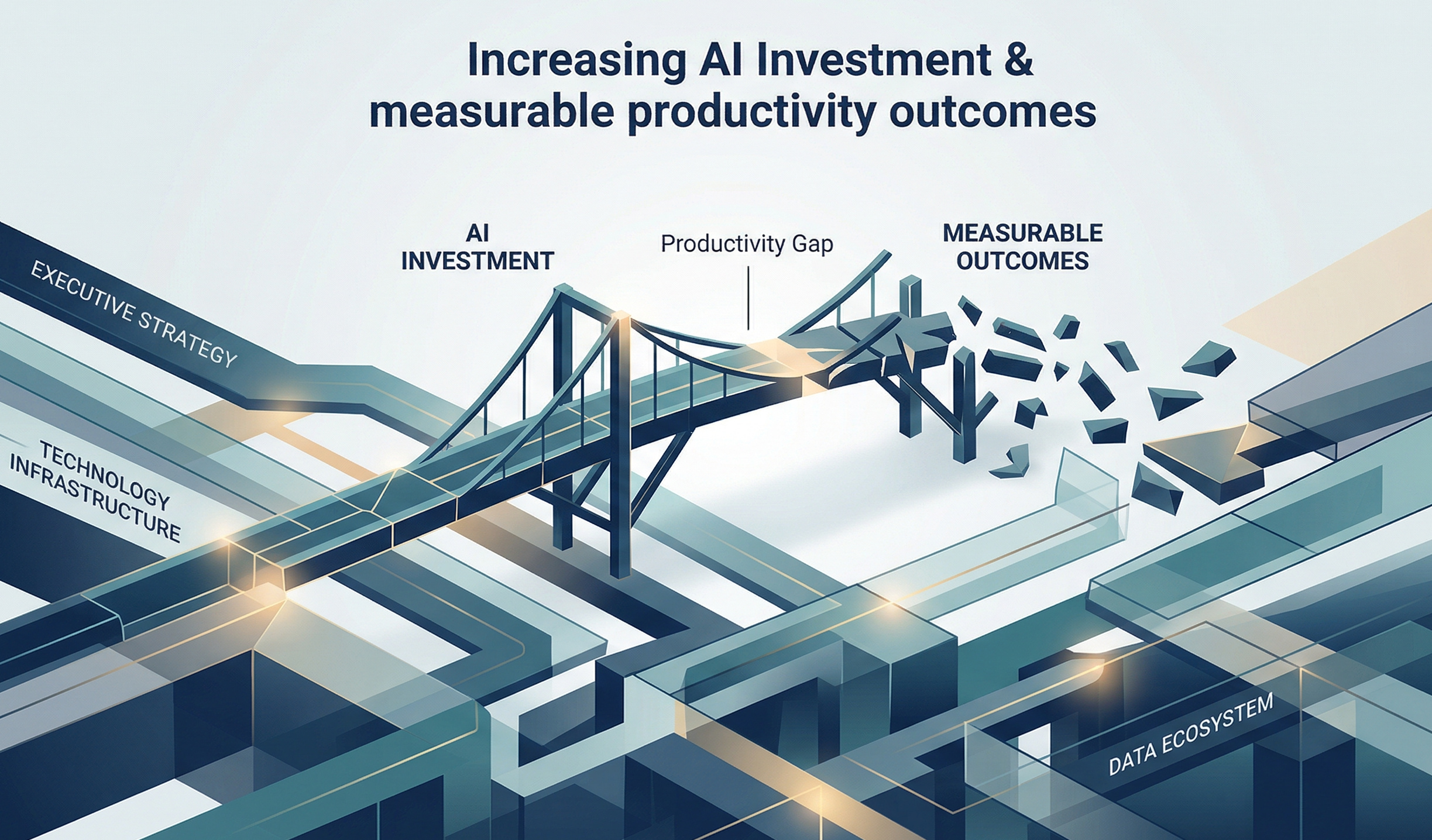
Fewer than one in four UK businesses can point to clear, measurable productivity gains from their AI investments. That is the central finding of a new research report from Snowflake, conducted in collaboration with YouGov, which surveyed 500 executives across large UK organisations. The gap between AI spending and AI impact is not a technology problem. It is an execution problem — and the barriers are overwhelmingly internal.
The productivity question UK leaders cannot avoid
The UK has a well-documented productivity problem. Between 2010 and 2022, annual average growth in GDP per hour worked was just 0.5%, compared with 0.8% in the United States. The UK ranks fourth among G7 nations for productivity, sitting 20% below US levels. Government and business leaders have increasingly positioned AI as the answer — the 2025 AI Opportunities Action Plan estimates that widespread adoption could boost the UK economy by £47 billion annually and increase national productivity by up to 1.5% every year.
Strategic Context: The UK’s productivity gap is not new, but the scale of expectation placed on AI to close it is. When government policy assumes a 1.5% annual productivity uplift from AI, the pressure on businesses to deliver measurable results becomes a strategic imperative, not an optional experiment.
The survey data confirms that UK business leaders share this optimism. Fifty-seven per cent of organisations expect AI investment to increase over the next 12 to 24 months, with another 27% expecting it to remain at current levels. Nearly a quarter of respondents anticipate a 20% increase in overall AI spending. A further 33% expect increases of 30–50%, and about 8% are planning increases of 60% or more.
The money is flowing. The question is whether it is producing results.
Where the gains are — and where they are not
| AI maturity stage | Percentage of respondents |
|---|---|
| Clear, measurable gains across many use cases | 23% |
| Measured gains in a small number of specific use cases | 24% |
| Early signs of improvement, not yet measured | 20% |
| Still largely experimental | 22% |
| Not using AI in a meaningful way | 8% |
The picture is more nuanced than the headline figure suggests. Nearly half of respondents (47%) report some measurable impact, either broadly or in specific cases. Another 20% see early positive signals. Only 8% are not engaging with AI at all. These are reasonable adoption curves for a technology at this stage of maturity.
Reality Check: The 23% reporting broad measurable gains is actually a strong signal. Most enterprise technology deployments take years to show cross-functional impact. The concern is not that gains are slow — it is that 22% of organisations are still in experimental mode with no clear path to scale.
But there is a fundamental measurement problem. When asked what success looks like, respondents split across multiple objectives: 44% prioritise cost reduction, 39% cite customer experience improvements, 36% point to innovation delivery, and 26% focus on revenue growth. Employee efficiency and productivity ranks as the top expected enabler (46%), followed by better use and integration of data (45%) and faster decision-making (36%).
The lack of a unified definition of success makes it difficult to know whether AI is actually delivering what the business needs, or simply doing things that happen to be measurable.
The real bottleneck is not the technology
The most striking finding in the report is what businesses identify as their biggest barriers to AI productivity. The top obstacles are:
- Data quality issues — 31%
- Budget limitations — 29%
- Resistance to change — 27%
- Inefficient processes and workflows — 25%
- Lack of skilled workforce — 17%
- Organisational silos — 17%
- Unclear leadership or strategic direction — 17%
Critical Context: Notice what is absent from the top of this list. Technology capability, model performance, and vendor selection barely register. The barriers are data foundations, organisational culture, and leadership clarity. These are problems that more AI spending cannot solve on its own.
Only 24% of organisations have a rigorous framework for aligning AI initiatives to business objectives. A third report clear alignment in some cases, 23% describe their alignment as occasional or inconsistent, and 10% admit they launched AI projects without defined business objectives at all.
This is the core execution gap. Organisations are investing in AI without the internal structures to ensure that investment translates into business value. The data suggests that fixing this gap matters more than choosing better models or platforms.
Who owns AI in the business — and why it matters
The report reveals an ownership split that explains much of the execution challenge. Across surveyed organisations, 52% report that executive leadership is responsible for allocating AI investment. But only 43% say technology leadership is responsible for executing rollouts, and just 10% say data leadership holds responsibility.
| Function | Investment responsibility | Execution responsibility |
|---|---|---|
| Executive leadership | 52% | — |
| Technology leadership | 26% | 43% |
| Data leadership | — | 10% |
| Resource allocation | — | 5% |
Strategic Insight: The people controlling the budget are not the same people running the projects. Executive leaders hold the purse strings but technology teams manage delivery. Data leaders — the people closest to the foundational asset AI depends on — have almost no ownership. This disconnect between funding, execution, and data governance is a structural barrier to scaling AI.
This split is not inherently a problem. Most technology investments involve budget holders and delivery teams operating separately. But when 31% of organisations cite data quality as their top barrier, and data leaders have minimal ownership of AI initiatives, there is a clear misalignment. The function that understands data quality best has the least influence over how AI is deployed.
Trust and governance as accelerators, not brakes
One of the report’s more counterintuitive findings concerns regulation and governance. Far from being obstacles, most respondents view them as enablers.
Eighty-five per cent say ethics and safety considerations will shape their AI adoption decisions. Fifty-three per cent say regulation and governance either actively accelerate AI adoption (11%) or enable more confident and stable use (42%). Another 27% see regulation as a necessary safeguard. Only 6% view governance as an inhibitor.
Strategic Reality: The narrative that regulation slows AI adoption is not supported by this data. The vast majority of UK business leaders want governance frameworks — not because they oppose AI, but because they need institutional confidence before scaling. Regulation is a precondition for enterprise adoption, not an obstacle to it.
The public sector provides an instructive contrast. Public sector respondents are more focused on risk and governance than their private sector counterparts. Less than half cite regulatory or reputational risk as a top concern — but two-thirds say ethics and safety concerns significantly influence their AI adoption decisions. And 52% expect AI will not materially improve their productivity for at least two years, compared with lower figures across the private sector.
This caution is understandable. Public services carry accountability requirements that the private sector does not. But the report identifies a risk: if the public sector moves too slowly while the private sector scales, the nationwide productivity benefits that government policy depends on may not materialise within expected timeframes.
Four barriers that do not appear in the headline data
Beyond the survey’s explicit findings, several less obvious challenges emerge from the report’s structure and framing.
The measurement gap is self-reinforcing. Organisations that cannot measure AI’s impact have no evidence to justify further investment, which limits the scale of deployment, which further limits the ability to demonstrate impact. Without deliberate investment in measurement frameworks, early-stage adopters risk becoming permanently stuck in pilot mode.
Expectations and timelines are misaligned. Eighty-three per cent of respondents expect AI to materially improve their productivity, but only 21% expect this within 12 months. The majority expect it to take one to five years. Meanwhile, 57% are increasing investment now. The gap between current spending and expected returns creates pressure to demonstrate short-term wins that may not reflect AI’s actual value trajectory.
Hidden Cost: When boards expect visible returns on a 12-month cycle but AI delivers its strongest productivity gains over 2–5 years, the result is premature project cancellation. The organisations that succeed will be those that build executive patience into their AI governance models.
Data quality is both the problem and the solution. Thirty-one per cent cite data quality as a barrier to AI productivity. But 45% also say better use and integration of data is one of the top ways AI will enable business outcomes. The relationship is bidirectional — you need good data to get value from AI, and you can use AI to improve data quality. Organisations that treat these as separate initiatives are missing the feedback loop that makes both work.
Cultural resistance outweighs technical barriers. Twenty-seven per cent cite resistance to change, 25% cite inefficient processes, and 17% cite organisational silos. Combined, these cultural and structural barriers affect more organisations than any single technical challenge. Yet most AI strategies focus on technology selection and deployment, not on the organisational change management required to make those deployments effective.
What UK organisations should do differently
The report’s findings point to a clear set of priorities for organisations at different stages of AI maturity.
For organisations still experimenting (22% of respondents)
- Define business objectives before selecting AI tools — the 10% that launched without objectives are a warning signal
- Invest in data quality assessment before scaling any AI initiative
- Establish baseline productivity metrics so future gains can actually be measured
For organisations seeing early results (44% of respondents)
- Build a rigorous business alignment framework — only 24% currently have one
- Close the ownership gap between executives who fund AI and data teams who understand its foundations
- Create measurement dashboards that connect AI project outcomes to specific business KPIs
For organisations with measured gains (23% of respondents)
- Address organisational silos and cultural resistance that prevent gains from spreading across functions
- Use proven use cases to build the internal case for longer investment timelines
- Establish governance frameworks that enable confident scaling rather than limiting deployment
Take Action: The single most impactful step for most UK organisations is not more AI spending. It is creating a formal framework that connects AI initiatives to measurable business objectives, with clear ownership at the data leadership level.
The bottom line
UK businesses are not short of AI ambition. The investment is there, the belief is there, and nearly half of large organisations are already seeing some measurable return. But the path from investment to productivity impact runs through internal barriers that technology alone cannot solve.
Data quality, organisational alignment, leadership ownership, and measurement frameworks are the four foundations that determine whether AI investment produces economic value or expensive experimentation. The organisations that address these foundations first will be the ones that deliver the productivity gains the UK economy needs.
The report makes a persuasive case that AI has the potential to be the productivity accelerator that UK policymakers and business leaders are looking for. But potential is not impact. The journey from one to the other requires less focus on the AI itself and more attention to the organisational infrastructure that makes AI work.
Three success factors for UK AI productivity:
- Align before you invest — build business-objective frameworks before scaling AI deployments
- Fix the data first — treat data quality as the prerequisite for AI value, not a parallel initiative
- Close the ownership gap — give data leadership a seat at the AI strategy table alongside executive and technology leaders
Source: The UK Journey from AI Investment to Impact, Snowflake and YouGov, 2026. Survey of 500 UK executives from organisations with 250+ employees across manufacturing, financial services, retail, and the public sector.