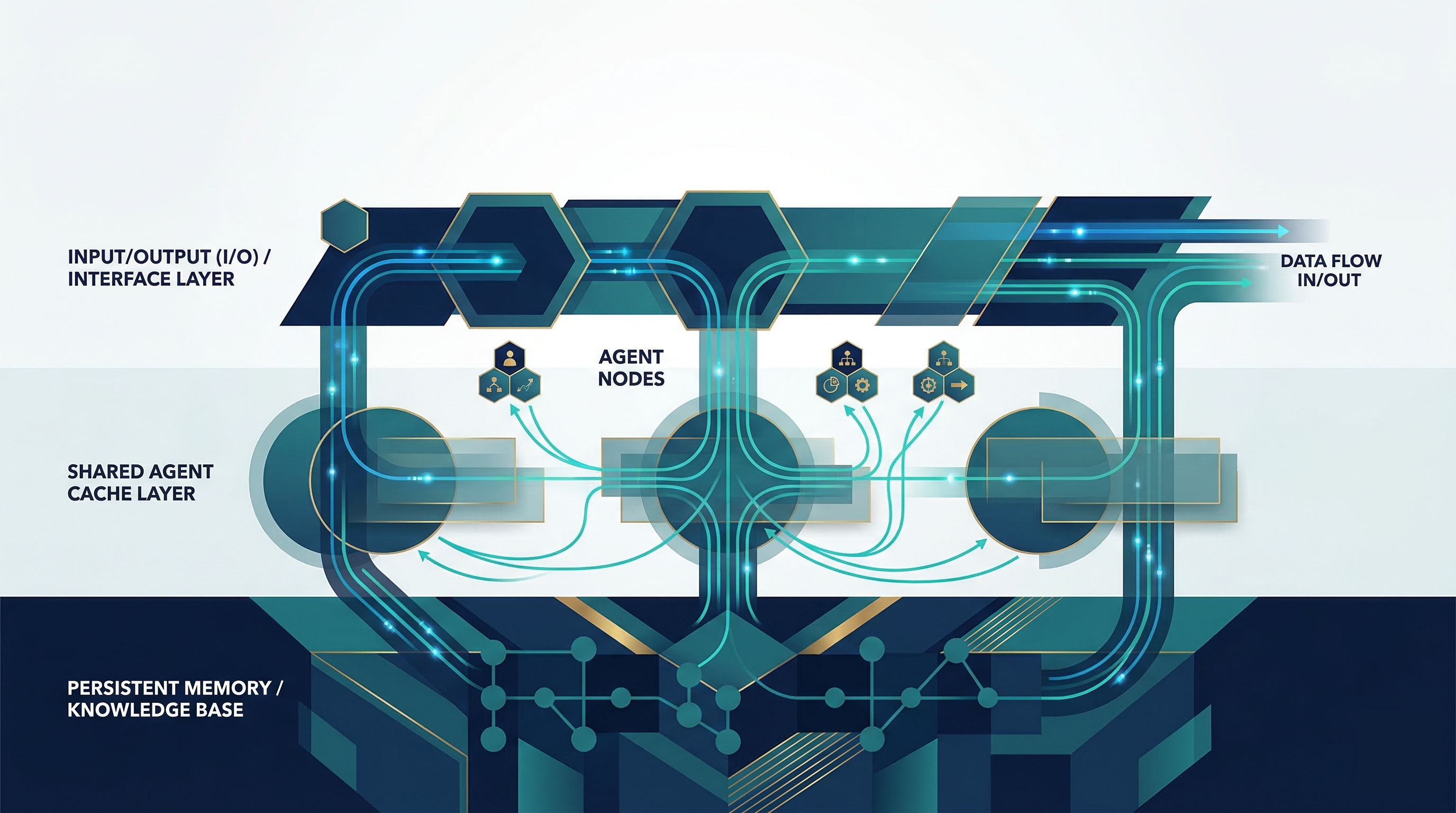
When multiple AI agents work together, they share something surprisingly familiar to anyone who has built computer systems: a memory problem. A new position paper from UC San Diego frames multi-agent memory through the lens of computer architecture, and the parallels it draws aren’t academic curiosities — they’re a practical roadmap for anyone building agent systems that need to actually work.
The memory bottleneck nobody talks about
The rush to deploy multi-agent AI systems has focused heavily on reasoning capabilities, tool use, and orchestration patterns. But researchers at the University of California, San Diego argue that the real constraint is more fundamental: how agents manage, share, and keep their memory consistent.
Their position paper, presented at the Architecture 2.0 Workshop in Pittsburgh, makes a straightforward claim: multi-agent memory is a computer architecture problem. The same challenges that hardware engineers solved decades ago — bandwidth, hierarchy, caching, and consistency — are now resurfacing in AI systems where multiple agents read from and write to shared context.
Strategic Reality: Most multi-agent frameworks today treat memory as an afterthought. Agents dump information into shared vector stores or pass messages without formal protocols. This works for demos. It breaks in production.
The research team distinguishes between two fundamental memory paradigms borrowed directly from computer systems:
| Memory model | How it works | Strength | Risk |
|---|---|---|---|
| Shared memory | All agents access a common pool (e.g., a shared vector database) | Easy knowledge reuse across agents | Without coordination, agents overwrite each other, read stale data, or act on inconsistent facts |
| Distributed memory | Each agent maintains local memory and synchronises selectively | Better isolation and scalability | State divergence between agents unless carefully managed |
Most production systems sit between these extremes, combining local working memory with selectively shared artefacts. But few have formal protocols governing how that sharing actually works.
A three-layer hierarchy that maps to real systems
The paper’s most actionable contribution is a three-layer memory hierarchy adapted from hardware architecture. For organisations building or evaluating multi-agent systems, this framework offers a useful mental model:
Agent I/O layer handles ingestion and output — audio, text documents, images, network calls. This is where raw information enters the system and where agents communicate with the outside world.
Agent cache layer provides fast, limited-capacity memory for immediate reasoning. Think compressed context, recent tool call results, short-term latent storage such as KV caches and embeddings. This is your agent’s working memory.
Agent memory layer is the large-capacity, slower storage optimised for retrieval and persistence — full dialogue history, vector databases, graph databases, and document stores.
Implementation Note: The researchers frame a key principle that matters for system design: agent performance is an end-to-end data movement problem. If the right information is stuck in the wrong layer (or never loaded), reasoning accuracy and efficiency degrade. Getting data to the right layer at the right time isn’t optional.
This maps directly to problems organisations encounter in practice. An agent that can’t access its conversation history quickly enough produces inconsistent responses. A team of agents sharing a vector store without cache management creates redundant embeddings and conflicting retrievals.
Two protocol gaps that affect production systems
The paper identifies two missing pieces that should concern anyone running multi-agent systems at scale:
1. Agent cache sharing protocol
Recent work on KV cache sharing between language models has explored how one agent’s cached results might be reused by another — similar to cache transfers between processors. But there’s no principled protocol for this. The result is that agents frequently recompute information that another agent has already processed, wasting compute and introducing inconsistencies.
Hidden Cost: Without cache sharing protocols, organisations running multiple agents on overlapping tasks pay for redundant computation. Each agent independently processes and caches information that could be shared, inflating inference costs with no improvement in output quality.
2. Agent memory access protocol
Even frameworks that support shared state leave the actual access protocol underspecified. Can one agent read another’s long-term memory? Is access read-only or read-write? What’s the unit of access — a document, a chunk, a key-value record, or a trace segment? These questions sound academic until an agent overwrites another agent’s carefully constructed reasoning chain.
Critical Context: The Model Context Protocol (MCP) handles agent connectivity and communication, but inter-agent bandwidth remains limited by context. The researchers argue this layer is necessary but not sufficient — formal memory access rules are the missing piece.
The consistency challenge
The paper’s strongest argument concerns multi-agent memory consistency, which the researchers call the “largest conceptual gap” in current systems.
In computer architecture, consistency models define which updates are visible to a read operation and in what order concurrent updates may be observed. The researchers argue agent memory needs an analogous concept.
For a single agent, consistency means that memory stays temporally coherent — new information integrates without contradicting established facts, and retrievals reflect the most current state. This is already hard. When multiple agents read from and write to shared memory concurrently, the problem compounds with classical challenges around visibility, ordering, and conflict resolution.
The researchers decompose multi-agent memory consistency into two requirements:
Read-time conflict handling: Records evolve across versions and stale artefacts may remain visible. When Agent A updates a shared document while Agent B is reading an older version, the system needs rules for what happens next.
Update-time visibility and ordering: When an agent’s writes become observable to others, and how concurrent writes may be observed in a permissible order. Without this, two agents can simultaneously update the same knowledge base with contradictory information, and neither detects the conflict.
Strategic Insight: This is harder than classical computing consistency for a specific reason: memory artefacts in agent systems are heterogeneous (evidence, tool traces, plans) and conflicts are often semantic rather than bitwise. Two agents can write different summaries of the same source material, and determining which is “correct” requires understanding meaning, not just timestamps.
What this means for UK organisations building with agents
The shift from single-agent tools to multi-agent systems is accelerating across UK businesses. But the infrastructure supporting these deployments often lacks the architectural rigour this paper calls for.
| Stakeholder | Current reality | What changes |
|---|---|---|
| Technical leads | Agents share context via ad-hoc message passing or shared vector stores | Need formal memory hierarchies with defined access protocols |
| Product managers | Agent behaviour is unpredictable when memory conflicts occur | Consistency models make agent behaviour more determinable |
| Risk and compliance | No visibility into what agents “remember” or how memory conflicts resolve | Structured memory access enables audit trails and governance |
| Finance | Redundant computation across agents inflates inference costs | Cache sharing protocols reduce duplicate processing |
SME Advantage: Smaller organisations adopting multi-agent systems can design memory architectures correctly from the start, rather than retrofitting. This is cheaper and less disruptive than the path larger enterprises face with legacy agent deployments.
Practical steps for getting ahead of the memory problem
The paper is a position piece — it identifies problems rather than shipping solutions. But the framework it provides is immediately useful for evaluation and planning:
For organisations evaluating multi-agent platforms
- Ask about memory architecture: Does the platform distinguish between working memory (cache) and long-term memory? How does information move between layers?
- Test for consistency: Run two agents against the same shared context with overlapping writes. Check whether the system detects or resolves conflicts.
- Check access controls: Can agents read each other’s memory? Is there granularity — document-level, chunk-level, or field-level access?
For teams building custom agent systems
- Define your memory model early: Decide whether agents share memory, maintain distributed local stores, or use a hybrid. Document the access rules.
- Implement versioning: Track memory state changes so that conflicts can be detected and resolved rather than silently overwritten.
- Monitor data movement: Measure how often agents access each memory layer. If agents frequently miss the cache and hit the full memory store, your hierarchy isn’t working.
Take Action: Before scaling from prototype to production, map your agent system’s memory architecture against the three-layer hierarchy proposed here. Identify where information bottlenecks occur and where consistency gaps could produce unreliable outputs.
Four challenges the paper doesn’t solve (yet)
Semantic conflict resolution remains open. When two agents produce conflicting interpretations of the same data, no current protocol can automatically determine which is correct. This requires domain-specific resolution strategies that vary by use case.
The cost of consistency is undefined. Stronger consistency guarantees mean more coordination overhead between agents, which increases latency and compute costs. The paper doesn’t model these trade-offs, leaving organisations without guidance on how much consistency they can afford.
Cross-framework interoperability is unaddressed. Organisations increasingly run agents built on different frameworks (LangChain, AutoGen, custom stacks). Memory protocols need to work across these boundaries, not just within a single framework.
Real-time performance requirements vary wildly. A customer-facing chatbot team needs sub-second memory access. A research synthesis pipeline can tolerate minutes. The hierarchy needs to flex, and the paper doesn’t explore how.
The bottom line
Multi-agent AI systems are heading toward the same architectural walls that computer systems hit decades ago. The UC San Diego team’s contribution is framing this clearly: memory hierarchy, caching protocols, and consistency models aren’t nice-to-haves for agent systems. They’re prerequisites for reliability at scale.
The organisations that recognise this early — and design their agent architectures with formal memory management — will build systems that scale predictably. Those that don’t will discover, as hardware engineers did before them, that informal memory management works fine until it doesn’t.
Strategic Reality: The shift from “agents that work in demos” to “agents that work in production” runs through memory architecture. This paper provides the conceptual vocabulary for that transition.
Three factors that will determine success:
- Architectural discipline — treating agent memory as an engineering problem, not an afterthought
- Protocol adoption — implementing formal rules for how agents share and access memory
- Consistency investment — accepting the overhead cost of keeping shared context coherent
Next steps:
- Audit your current multi-agent memory architecture against the three-layer hierarchy
- Identify where agents share state without formal access protocols
- Test for memory consistency failures under concurrent agent workloads
- Evaluate your platform’s cache sharing capabilities between agents
Source: Yu, Z., Yu, N., Zhang, H., Ni, W., Yin, M., Yang, J., Zhao, Y., & Zhao, J. (2026). Multi-Agent Memory from a Computer Architecture Perspective: Visions and Challenges Ahead. Proceedings of Architecture 2.0 Workshop on AI for Computing Systems Design, Pittsburgh, PA, USA.
Analysis by Resultsense — Making sense of AI in the UK.