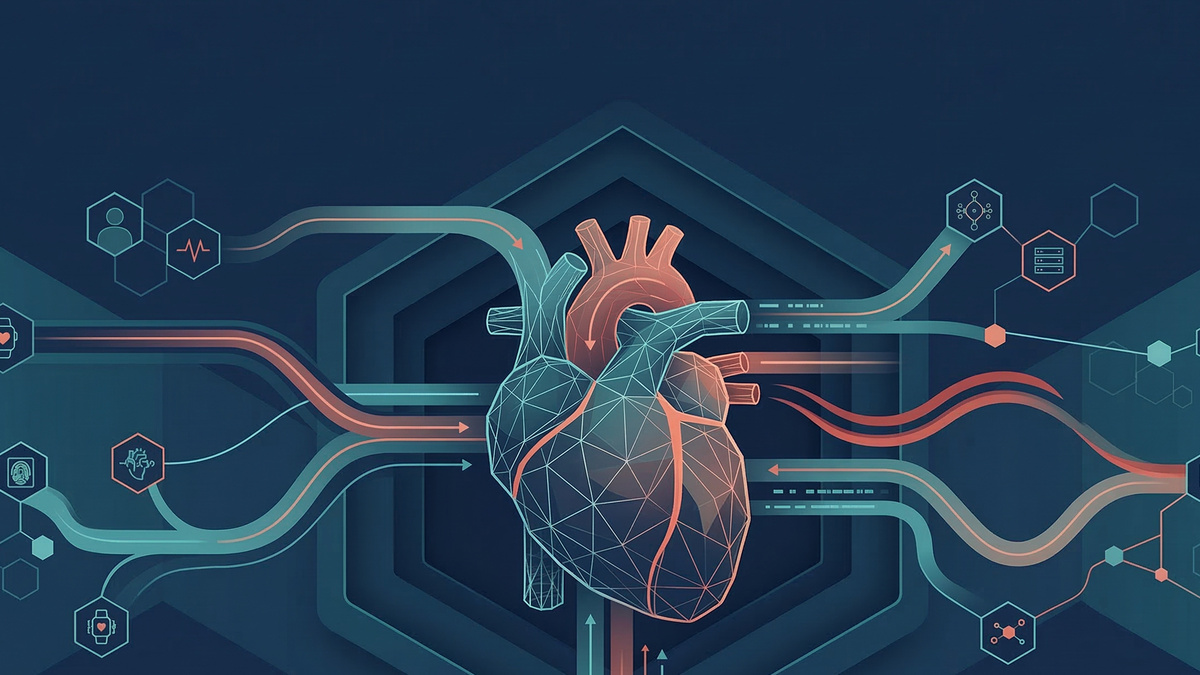
A virtual copy of your heart that doctors can use to test treatments before they touch your body. It sounds like a pitch from a sci-fi film, but a UK research consortium is building exactly that — and the implications stretch well beyond cardiology.
Why personalised cardiac models matter now
Pulmonary Arterial Hypertension (PAH) is a condition where the arteries in the lungs stiffen and narrow, forcing the heart to work harder until, in many cases, it fails. The numbers are grim: up to 77% of patients do not survive five years, even with the best available treatment. Diagnosis often requires invasive procedures, and research suggests that risk increases at pulmonary artery pressures above 15mmHg — lower than the 20mmHg diagnostic threshold currently used in clinical practice.
The core problem is that PAH treatment relies on a one-size-fits-all model. Clinicians base decisions on how the “average” patient responded in clinical trials. But patients are not averages. Their physiology varies, their responses to drugs differ, and their disease progression follows individual paths.
Strategic Reality: When 77% of patients die within five years despite optimal care, the treatment model itself is the variable worth changing. Digital twins offer a way to test that hypothesis patient by patient.
| Metric | Current state | With digital twins |
|---|---|---|
| Treatment approach | Based on average trial response | Personalised simulation per patient |
| Diagnostic threshold | 20mmHg (invasive measurement) | Continuous monitoring from 15mmHg |
| Data sources | Periodic clinic visits | Wearables, MRI, catheterisation, self-reports |
| Treatment testing | Trial and error on real patients | Virtual scenario modelling first |
How cardiac digital twins actually work
A digital twin is not a static 3D model of a heart. It is a continuously updated virtual replica that mirrors what is happening inside a patient’s cardiovascular system in something close to real time.
The process starts with data from multiple sources: MRI scans revealing the unique geometry of a patient’s heart, catheterisation measuring exact blood pressures, exercise tests gauging real-world function, and wearable devices tracking activity, heart rhythms, and sleep patterns. These strands form what researchers call a “personal digital thread” — a living dataset specific to one individual.
From that thread, two complementary modelling approaches build the twin:
Physics-based modelling uses established laws of fluid dynamics and cardiac mechanics to simulate how blood flows through heart chambers, how pressure waves propagate through arteries, and how heart muscle contracts with each beat. Think of it as an engineering schematic of the cardiovascular system. It handles the well-understood mechanics reliably but struggles with individual variation.
Data-driven modelling uses machine learning to find patterns that physics alone cannot capture. Why do some patients with similar heart function have vastly different exercise capacity? What subtle signals predict who will respond to a particular medication? These algorithms excel at the messy, unpredictable aspects of human biology.
Critical Context: Neither approach works well alone. Physics models miss individual quirks. Data models miss causal mechanisms. The real advance is combining them so that physical laws constrain the machine learning, and machine learning fills the gaps that physics cannot reach.
The resulting twin lets clinicians run scenarios: testing specific drug combinations, modelling aggressive versus conservative treatment, and identifying a patient’s next high-risk period — all without touching the patient.
The UK research effort behind CVD-Net
The Networks of Cardiovascular Digital Twins project (CVD-Net) brings together researchers from the Alan Turing Institute, Imperial College London, the University of Sheffield, and the University of Nottingham. Funded by UKRI’s Engineering and Physical Sciences Research Council (EPSRC grant EP/Z531297/1), the project is led by Professor Steven Niederer.
Their approach follows a deliberate validation ladder:
- Prove the basics — show that continuous wearable and implant data reveals something clinically valuable beyond routine clinic visits
- Validate predictions — demonstrate that computational models can accurately forecast measurable outcomes like lung pressures
- Tackle what matters — prove the twins can predict hospitalisations, treatment responses, and survival
- Keep humans central — build trustworthy systems that doctors can actually use and patients can understand
Success Factor: The validation ladder is the right structure. Too many digital health projects jump straight to “predict outcomes” without first proving their data inputs are reliable. CVD-Net’s staged approach builds credibility with clinicians, which is the real bottleneck for adoption.
PAH patients are a particularly good test population. They are already closely monitored, motivated to engage with new technologies, and dealing with a disease complex enough — involving heart, lung, and vascular dysfunction simultaneously — to genuinely stress-test whether digital twins can handle medicine’s hardest problems.
What this means for UK organisations
The implications of cardiac digital twins extend beyond healthcare research. The underlying pattern — building a continuously updated virtual model from diverse data sources to personalise decisions — is relevant to any organisation grappling with one-size-fits-all approaches.
For NHS trusts and healthcare providers, the immediate question is readiness. Digital twins require data infrastructure that most trusts do not yet have: interoperable systems that can combine imaging, monitoring, wearable, and patient-reported data in near real time. The investment case will depend on whether CVD-Net’s validation ladder produces convincing evidence at each stage.
For health technology companies, the hybrid physics-plus-ML architecture is worth studying. Pure data-driven approaches face a credibility problem in clinical settings — doctors want to understand why a model makes a recommendation, not just that it does. Physics-based constraints give the model explanatory power that pure ML lacks.
For organisations outside healthcare, the digital twin concept is already spreading into manufacturing, infrastructure, and urban planning. The lessons from CVD-Net about combining mechanistic and data-driven models, managing data from incompatible sources, and building validation ladders apply directly.
SME Advantage: Smaller health-tech firms can move faster than NHS institutions on data integration. If you are building products that aggregate patient data from multiple sources, the CVD-Net architecture offers a credible technical template.
| Stakeholder | Primary opportunity | Key barrier |
|---|---|---|
| NHS trusts | Personalised treatment pathways | Data interoperability across systems |
| Health-tech companies | Hybrid modelling products | Regulatory approval timelines |
| Pharmaceutical firms | In-silico clinical trial platforms | Validation evidence still emerging |
| Wearable device makers | Clinical-grade data partnerships | Accuracy standards for medical use |
| UK AI research community | Cross-institutional collaboration model | Sustained funding beyond initial grant |
Four challenges that could slow progress
1. Computing power at clinical scale
Building one patient’s digital twin requires substantial processing. Scaling that to thousands of patients in routine clinical use demands computing infrastructure that most healthcare settings lack. Cloud computing helps, but introduces data sovereignty questions when patient cardiovascular data crosses organisational boundaries.
Implementation Note: The compute challenge is real but solvable. NHS trusts already use cloud services for imaging. The harder problem is funding the ongoing compute costs within existing healthcare budgets, not the technology itself.
2. Data arrives in incompatible formats
Patient data comes from MRI scanners, catheterisation labs, smartwatches, and patient questionnaires — each with different formats, update frequencies, and quality levels. Building a coherent digital thread from these sources requires data engineering that is often underestimated in clinical research projects.
3. Privacy when your heart has a digital copy
A virtual replica of someone’s entire cardiovascular system is sensitive data by any measure. Existing governance frameworks were not designed for this. The CVD-Net team’s recently published paper, “Realising the Digital Twin,” examines the ethical, legal, and social challenges, including algorithmic bias, regulatory gaps, and barriers to equitable adoption.
Warning: Privacy risk increases with fidelity. The more accurate a digital twin becomes, the more it reveals about a patient — potentially including conditions they have not yet been diagnosed with. Governance frameworks need to address incidental findings, not just data protection.
4. Automation or nothing
Handcrafting each patient’s twin with teams of engineers is not viable at scale. The process needs to be automated end-to-end: from data ingestion through model calibration to clinical output. This is an engineering problem as much as a scientific one, and it is where many promising medical technologies stall.
What to take from this
The CVD-Net project represents something more specific than “AI in healthcare.” It is an attempt to solve a defined problem — personalising treatment for a disease with a 77% five-year mortality rate — using a rigorous, staged validation approach that could set the template for digital twin adoption across medicine.
Three things matter most:
- The hybrid model works both ways. Physics grounds the machine learning; machine learning extends the physics. This architecture is more trustworthy to clinicians than pure data-driven approaches, and that trust is what determines adoption.
- Validation ladders prevent premature deployment. By proving data value before prediction accuracy before clinical outcomes, CVD-Net avoids the trap of promising too much too early. Other digital health projects should study this structure.
- The real bottleneck is infrastructure, not science. The modelling techniques exist. The challenge is building data pipelines, governance frameworks, and clinical workflows that make digital twins routine rather than research curiosities.
Next steps if this is relevant to your organisation:
- Assess your data integration maturity — can you combine data from four or more sources in near real time?
- Review the CVD-Net team’s technical paper for the specific modelling approaches
- Evaluate whether your domain has the equivalent of PAH’s “perfect storm” — a closely monitored population with high motivation and complex enough conditions to justify the investment
- If you are in health-tech, consider how the hybrid physics-plus-ML architecture might apply to your products
This analysis is based on research published by the Alan Turing Institute’s CVD-Net project, funded by UKRI EPSRC (grant EP/Z531297/1). The project is led by Professor Steven Niederer with collaborators from Imperial College London, the University of Sheffield, and the University of Nottingham. Original article: “Personalising healthcare with connected digital twins.”
Resultsense provides independent analysis of UK AI developments.