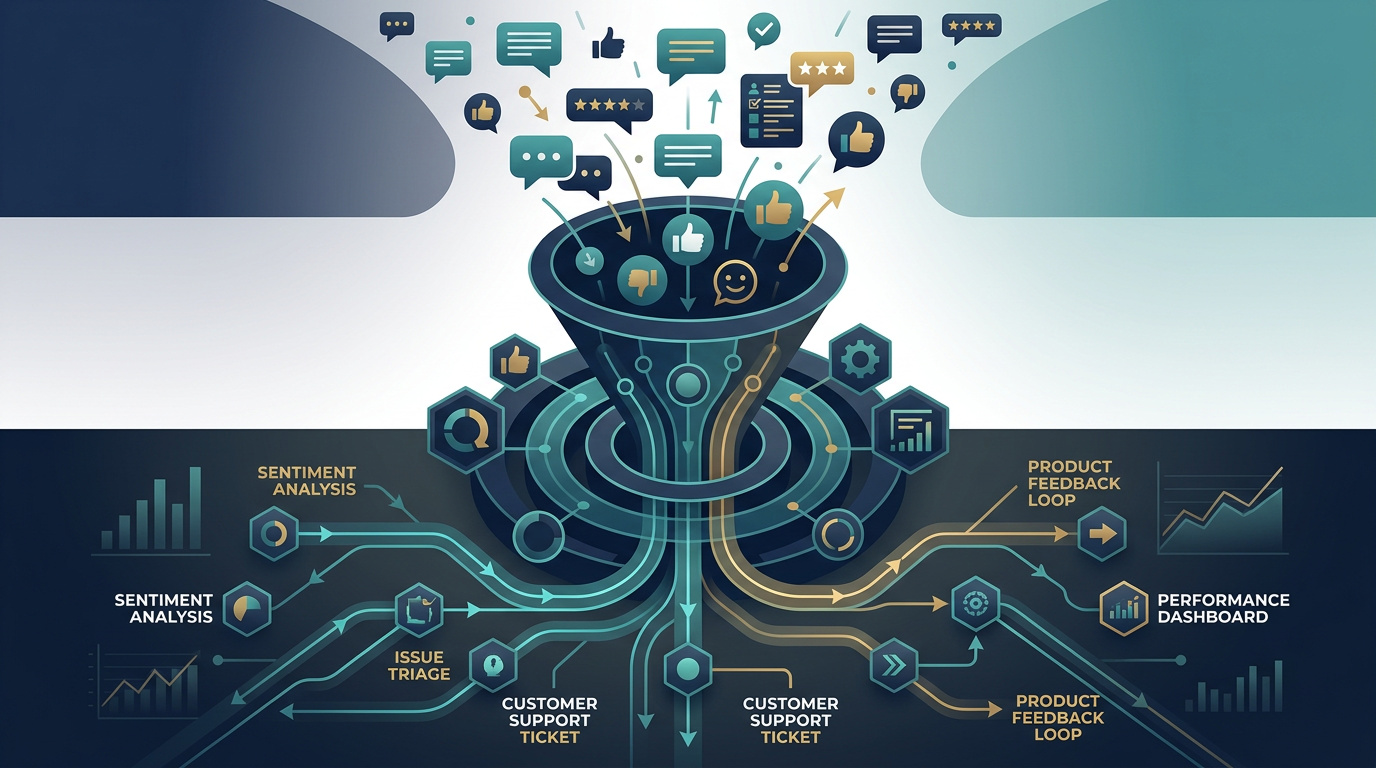
Most businesses treat online reviews as a reputation management problem. Respond to the angry ones, ignore the rest, move on. But a new NBER working paper from Guangyu Cao, Shenghao He, and Ginger Zhe Jin presents compelling evidence that the real value of consumer reviews sits elsewhere entirely: as structured operational intelligence that, when processed systematically, drives measurable quality improvements.
The feedback gap nobody talks about
Online review platforms generate enormous volumes of consumer feedback. The problem is not a shortage of information — it is the gap between receiving feedback and acting on it.
Consider the typical restaurant. Reviews arrive continuously across multiple formats: star ratings, text, photographs. They contain complaints, praise, sarcasm, and detailed accounts of specific experiences. A single outlet might receive dozens of reviews per week, each requiring someone to read, interpret, and decide whether action is needed.
Strategic Reality: The bottleneck in most service businesses is not information acquisition. It is attention, prioritisation, and execution — the cognitive and organisational cost of converting dispersed feedback into structured action.
In practice, most establishments lack dedicated staff for this work. Review monitoring falls to outlet managers already stretched across daily operations. The result is predictable: feedback gets checked sporadically, patterns go unnoticed, and the same complaints recur.
The research examines what happens when you remove this friction with technology.
What the research actually found
The paper studies an Automated Review Monitoring System (ARMS) deployed across 122 Chinese restaurants on Dianping, China’s dominant consumer review platform (268 million reviews, 8 million businesses). ARMS does two things:
- Automated negative review alerts — the system flags reviews with ratings below 3 stars or text classified as negative by machine learning, pushing notifications directly to staff mobile phones
- Work ticket management — each flagged review generates a trackable ticket where managers assign tasks, staff discuss remediation, and resolution gets confirmed
The researchers used a difference-in-differences design across the system’s staggered rollout. The numbers are striking.
| Metric | Change after ARMS adoption | Baseline | Percentage improvement |
|---|---|---|---|
| Average star rating | +0.358 | 4.265 | 8.4% |
| Negative review share | -0.077 | 0.081 | 95.1% reduction |
| Sentiment score | +0.119 | 0.622 | 19.1% |
Critical Context: These effects emerged approximately four weeks after implementation and persisted across the full 24-week observation window. This is not a novelty effect — it reflects sustained operational change.
The improvements were not confined to a single dimension. Across all six quality dimensions measured (food taste, service, environment, waiting time, price, food hygiene), restaurants showed gains. The strongest improvements appeared in service, waiting time, and price — areas where operational adjustments can happen quickly.
Ruling out gaming
The obvious objection is that restaurants might simply be gaming their reviews — bribing customers for five-star ratings or suppressing negative feedback. The researchers addressed this head-on with two tests.
First, they excluded all five-star reviews from the analysis. If manipulation were driving the results, five-star reviews would be disproportionately affected (staff soliciting fake reviews almost always ask for the maximum rating). The effects actually grew stronger: star ratings improved by 0.451 and negative reviews fell by 11.6 percentage points.
Second, they tested for “masked negativity” — cases where a review carries a high star rating but negative text sentiment. If staff were pressuring customers into giving high ratings, you would expect more of this disconnect. They found no increase. In one specification, masked negativity actually declined.
Reality Check: The quality improvements are genuine. Two distinct manipulation tests confirm that the gains reflect actual changes in consumer experience, not strategic distortion of review scores.
A third piece of evidence comes from an unexpected source: consumer behaviour itself. After ARMS adoption, reviews became longer, more detailed, and covered more quality dimensions. Prior research has consistently shown that review solicitation and incentivisation degrade review quality. The opposite pattern here — richer, more engaged reviews — further undermines any manipulation story.
The organisational culture factor
Here is where the research gets genuinely interesting for anyone thinking about technology adoption.
ARMS generates work tickets where staff discuss how to handle negative reviews. The researchers classified these internal discussions into two categories:
- Reflective — staff acknowledge operational shortcomings and focus on what the restaurant can improve
- Defensive — staff attribute complaints to consumer-related factors like unreasonable expectations
The difference in outcomes is dramatic.
| Staff attitude | Star rating improvement | Negative review reduction |
|---|---|---|
| Reflective | +0.510 | -10.9 percentage points |
| Defensive | +0.231 | -4.8 percentage points |
Restaurants with defensive cultures saw roughly half the quality improvement of their reflective counterparts. The technology was identical. The data pipeline was the same. The difference sat entirely in how staff interpreted and acted on the information.
Strategic Insight: Technology adoption without cultural readiness wastes money. A monitoring tool that surfaces problems only works if the organisation treats those problems as opportunities rather than threats.
This finding carries weight beyond the restaurant sector. Any business deploying AI-powered feedback analysis, customer insight tools, or operational monitoring systems faces the same dynamic. The technology is the easy part. The hard part is building an organisational culture that responds to negative signals with curiosity rather than defensiveness.
Back-end action replaces front-end performance
The study reveals a counterintuitive shift in how restaurants respond to reviews after ARMS adoption. Public managerial responses — the visible replies to reviews on the platform — actually declined significantly (by up to 47.5 percentage points).
This does not mean managers stopped caring. It means they redirected effort from visible reputation management toward invisible operational improvement. The structured back-end workflow introduced by ARMS partially substituted for front-end responses.
Implementation Note: A drop in public review response rates after deploying a feedback system is not a failure signal. It may indicate that staff are spending time fixing problems rather than writing apologetic replies.
The substitution was strongest in restaurants with reflective staff attitudes. These teams pivoted most sharply from public responses toward internal remediation. Defensive teams, by contrast, maintained higher public response rates — consistent with a reputation-management mindset that prioritises appearances over substance.
What the data means for UK businesses
The research context is Chinese restaurants, but the underlying dynamics apply directly to any service business dealing with high-volume consumer feedback. Several implications stand out.
The information problem is solved; the execution problem is not. Review platforms already aggregate vast amounts of consumer intelligence. The value add is not in collecting more data but in making existing data actionable — structuring it, routing it to the right people, and tracking whether remediation happens.
Lower-performing units benefit most. ARMS drove quality convergence across the restaurant chain. Establishments with lower pre-adoption ratings experienced larger gains. This suggests that automated feedback systems are most valuable where they are needed most — in underperforming operations that lack the bandwidth to monitor and respond to feedback manually.
SME Advantage: Small and mid-sized businesses, which typically lack dedicated customer insight teams, stand to gain the most from automated feedback processing. The technology is not replacing existing capability — it is creating capability that did not previously exist.
Staff training matters as much as software selection. The defensive-versus-reflective finding should give pause to any organisation planning to deploy AI-powered monitoring. Without complementary investment in training, incentive design, and leadership communication that fosters a learning orientation, the technology will underperform.
Four challenges that do not appear in the sales pitch
-
Cultural resistance scales with hierarchy. ARMS adoption was a top-down decision by chain headquarters. Individual restaurant managers had no choice. In less hierarchical organisations, resistance from middle management — who may view automated monitoring as surveillance rather than support — could undermine adoption entirely.
-
Alert fatigue is a real risk. The system flags every negative review. In high-volume environments, this could produce dozens of notifications daily. Without intelligent prioritisation or severity weighting, staff may begin ignoring alerts, reproducing the original problem in a new form.
-
The virtuous cycle depends on genuine improvement. Consumers wrote better reviews after ARMS adoption because they had better experiences. If a business deploys monitoring without actually fixing the problems it surfaces, the feedback loop breaks down — or worse, generates documented evidence of persistent failures.
-
Measurement bias toward the measurable. The six quality dimensions studied (food taste, service, environment, waiting time, price, food hygiene) are all relatively concrete. Subtler aspects of customer experience — atmosphere, staff warmth, consistency — may be harder to capture and improve through ticket-based workflows.
Warning: Deploying automated review monitoring as a pure technology initiative, without addressing organisational culture and staff capability, risks creating an expensive dashboard that nobody acts on.
The strategic takeaway
This research offers the clearest empirical evidence to date that automated feedback systems can drive genuine quality improvements — not through reputation management or review manipulation, but through structured operational change.
The core value proposition is straightforward: reduce the cognitive and organisational cost of converting consumer feedback into action. When that cost drops far enough, businesses can respond to problems they previously could not even identify.
Three success factors from the evidence:
- Systematic routing — feedback must reach the people who can act on it, not just the people who manage the brand
- Accountability through tracking — work tickets that assign responsibility and confirm resolution close the feedback loop
- Reflective culture — staff must treat negative feedback as diagnostic information, not personal criticism
Next steps for UK organisations considering similar approaches:
- Audit your current feedback-to-action pipeline: how long does it take for a customer complaint to reach someone who can fix the underlying problem?
- Assess organisational readiness: would your frontline teams treat automated negative feedback alerts as helpful or threatening?
- Start with the lowest-performing units: the evidence shows returns are highest where current feedback processing is weakest
- Pair any technology deployment with explicit training on reflective (not defensive) response to criticism
Source: Cao, G., He, S., & Jin, G. Z. (2026). “From Complaint to Action: Technology-Enabled Quality Improvement from Consumer Reviews.” NBER Working Paper No. 34934. National Bureau of Economic Research.
Analysis by Resultsense — Making sense of AI in the UK. For strategic guidance on implementing AI-powered feedback systems, explore our AI Strategy Blueprint or AI Implementation Support.