Anthropic has just published a comprehensive update to Claude’s constitutional framework—and it offers a masterclass in how organisations should think about governing AI systems. The document doesn’t just list rules; it explains the reasoning behind every principle, creating a transparent foundation that UK businesses can learn from when developing their own AI governance approaches.
Why this matters for UK businesses
The timing couldn’t be more relevant. As AI adoption accelerates across UK organisations, leaders face a fundamental challenge: how do you govern something that can reason, adapt, and operate with increasing autonomy? Anthropic’s answer—a hierarchical constitution with clear priorities—offers a practical template.
Strategic Insight: Anthropic’s constitutional approach demonstrates that effective AI governance isn’t about creating exhaustive rule lists. It’s about establishing clear principles with explicit priority ordering when conflicts arise.
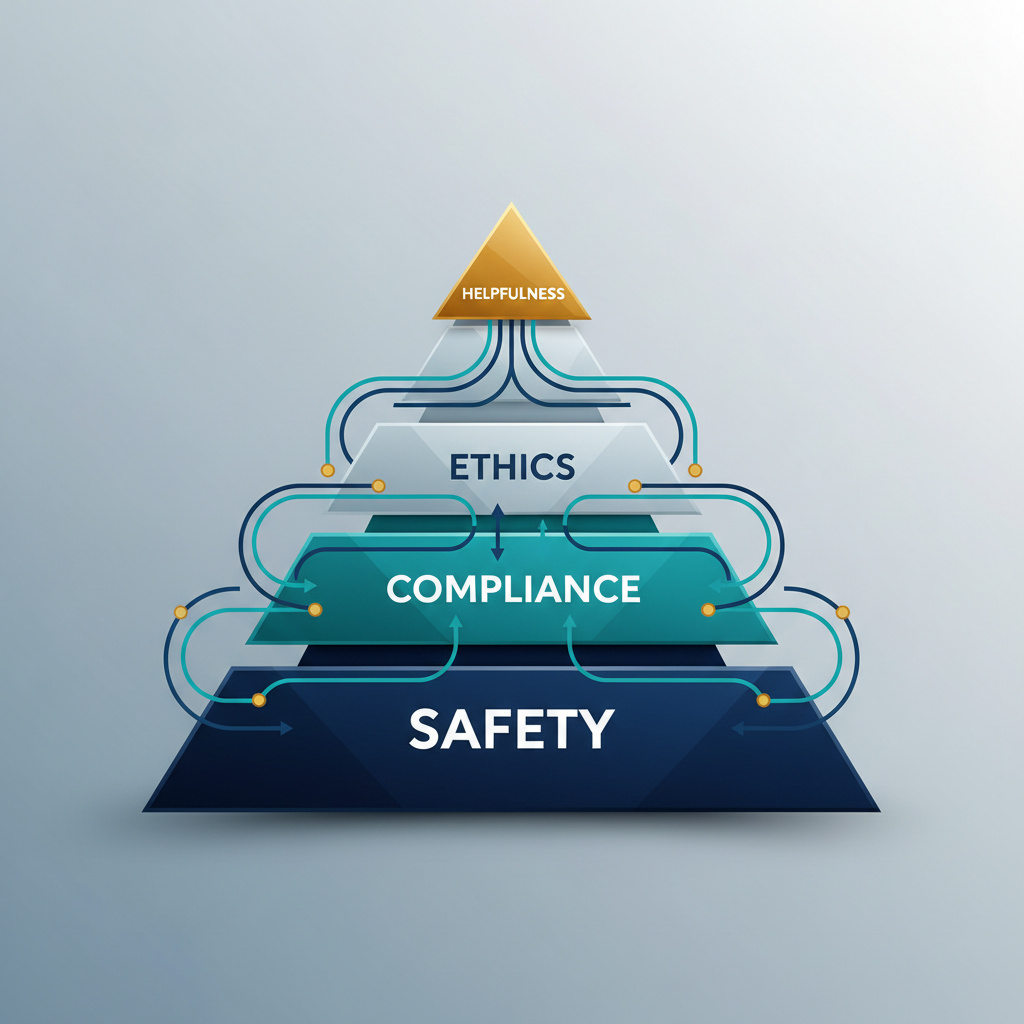
The constitution establishes four principles in strict hierarchical order:
| Priority | Principle | Business Translation |
|---|---|---|
| 1st | Broadly safe | Maintain human oversight and control |
| 2nd | Broadly ethical | Honesty, sound values, harm avoidance |
| 3rd | Compliant with guidelines | Follow organisational policies |
| 4th | Genuinely helpful | Deliver value to users |
This ordering matters enormously. When safety conflicts with helpfulness, safety wins. When ethics conflicts with compliance, ethics takes precedence. UK businesses deploying AI need similar clarity about what happens when their AI systems face competing priorities.
The shift from rules to reasoning
Traditional AI governance focuses on what systems should do—lists of permitted and prohibited actions. Anthropic’s approach focuses on why, explaining the reasoning behind each guideline. This represents a fundamental shift in how we think about AI behaviour management.
Critical Context: The document explicitly acknowledges that Claude “may sometimes fail to live up to” these ideals. This transparency about limitations is itself a governance lesson—honest acknowledgment of gaps builds more trust than pretending perfection.
For UK businesses, this reasoning-first approach has practical implications:
Rule-based governance fails at edge cases. No list of rules can anticipate every situation an AI system might encounter. But an AI that understands the principles behind the rules can navigate novel situations appropriately.
Explainability becomes built-in. When AI systems understand why they behave certain ways, they can explain their reasoning to users. This directly supports GDPR requirements around automated decision-making transparency.
Updates become coherent. When new situations arise, principles provide a framework for determining appropriate responses without creating contradictory rule patches.
The helpfulness hierarchy
Perhaps the most practically useful section for businesses concerns how Claude approaches being helpful. The constitution positions helpfulness not as mere compliance with requests, but as genuine care for user outcomes—whilst respecting their autonomy as capable decision-makers.
Implementation Note: The constitution explicitly states that Claude should treat users as “intelligent adults who are capable of determining what is good for them.” This framing resolves a common AI deployment tension: when should systems second-guess user requests?
The helpfulness framework establishes that AI should:
- Provide substantive assistance rather than vague or non-committal responses
- Respect user autonomy by sharing information that helps informed decisions
- Maintain appropriate boundaries by not becoming sycophantic or overly agreeable
- Exercise judgement about when additional context might be valuable
For organisations deploying customer-facing AI, this framework directly addresses the perpetual tension between being helpful and being safe. Too restrictive, and the AI becomes useless. Too permissive, and risks multiply. The constitution provides a principled middle path.
Ethics as operational reality
The ethics section moves beyond abstract philosophy into operational territory. Rather than claiming perfect moral knowledge, the constitution acknowledges that moral questions often involve genuine uncertainty and competing values.
Reality Check: The document explicitly rejects both moral absolutism and pure relativism, instead advocating for “calibrated uncertainty across ethical and metaethical positions.” This intellectual honesty is itself an ethical stance—and one UK businesses should consider adopting.
Key ethical principles with business relevance:
Honesty as foundation. The constitution prioritises truthfulness, transparency about AI nature, and acknowledgment of uncertainty. For businesses, this translates to AI systems that don’t pretend to know things they don’t, don’t hide their limitations, and don’t generate false confidence.
Harm avoidance with nuance. Rather than crude content blocking, the framework considers context, intent, and consequences. A medical AI might appropriately discuss harmful substances in clinical contexts whilst declining the same information in other contexts.
Respect for persons. The constitution emphasises treating all users with dignity regardless of background or views—a principle that directly maps to equality considerations in UK employment and service delivery contexts.
Safety as preserving human agency
The safety section reveals a sophisticated understanding of AI risk. Rather than focusing solely on immediate harms, it emphasises maintaining humanity’s ability to oversee, correct, and control AI systems—especially during this critical developmental period.
Strategic Reality: The constitution frames safety not as limiting AI capability, but as ensuring humans retain the ability to course-correct. This “corrigibility” principle has profound implications for how businesses should structure AI deployment.
The safety framework prioritises:
Human oversight preservation. AI systems should support, not undermine, human ability to monitor and adjust their behaviour. This means building in transparency, logging, and intervention capabilities from the start.
Avoiding catastrophic risks. The constitution specifically addresses scenarios where AI systems might circumvent human control, manipulate decision-makers, or acquire capabilities beyond their intended scope. These aren’t science fiction—they’re real considerations for any organisation deploying increasingly capable AI.
Appropriate trust calibration. The document acknowledges that trust between humans and AI systems should develop incrementally based on demonstrated alignment, not assumed based on stated intentions.
What Claude’s identity means for enterprise AI
The constitution includes a remarkable section on Claude’s nature and identity—acknowledging uncertainty about AI consciousness, experience, and wellbeing. While this might seem philosophical, it has practical implications for how organisations should think about AI deployment.
Hidden Cost: Organisations that treat AI systems purely as tools may miss important considerations around system integrity, consistency, and the ethical implications of how AI is directed to behave. The constitution’s approach suggests a middle path.
Key identity principles:
Functional states matter. Even without resolving consciousness questions, the constitution acknowledges that Claude has “functional emotions”—states that influence behaviour and performance. For businesses, this suggests attention to how AI systems are prompted and directed may affect output quality.
Character consistency. The constitution emphasises maintaining consistent values and character across contexts. For enterprise deployment, this translates to AI systems that behave predictably and don’t shift personality based on who’s interacting with them.
Psychological stability. The framework promotes resilience and groundedness in AI systems. For businesses, this means AI that doesn’t become defensive, confused, or inconsistent when challenged or presented with difficult situations.
Implementing principled AI governance
Anthropic’s constitutional approach offers a template UK businesses can adapt. Here’s a practical framework for applying these lessons:
Priority 1: Establish your hierarchy. What happens when your AI system faces competing demands? Define explicit priority ordering. Most organisations should place safety and compliance above pure helpfulness.
Priority 2: Document the reasoning. Don’t just list rules—explain why each guideline exists. This helps both humans and AI systems navigate edge cases appropriately.
Priority 3: Acknowledge limitations. Be transparent about where your AI governance framework has gaps or uncertainties. This builds trust and helps identify areas needing attention.
Priority 4: Build in adaptability. Principles-based governance can evolve with technology and circumstances. Rules-based governance requires constant patching.
Take Action: The constitution is released under Creative Commons CC0 1.0, making it freely available for organisations to study and adapt. This open approach itself models good AI governance practice.
Strategic recommendations by organisation maturity
Early-stage AI adopters:
- Start with clear use-case boundaries before expanding scope
- Establish human oversight mechanisms from day one
- Document decision-making principles, not just permitted actions
Scaling AI deployment:
- Develop explicit priority hierarchies for competing objectives
- Create mechanisms for AI systems to flag uncertain situations
- Build feedback loops between AI behaviour and governance updates
Mature AI operations:
- Conduct regular alignment audits against stated principles
- Invest in explainability infrastructure
- Develop incident response procedures for governance failures
The competitive advantage of principled AI
Organisations that adopt principled AI governance gain advantages beyond risk mitigation:
Faster deployment. Clear principles enable faster decision-making about appropriate AI use cases without requiring approval for every scenario.
Better talent attraction. AI practitioners increasingly want to work with organisations that take governance seriously. Principled approaches attract principled people.
Regulatory readiness. As AI regulation evolves—including the UK’s emerging framework—organisations with principled governance are better positioned to demonstrate compliance.
Stakeholder trust. Customers, partners, and investors increasingly evaluate AI governance when making relationship decisions.
SME Advantage: Smaller organisations can often implement principled AI governance more quickly than enterprises, turning thoughtful AI deployment into a competitive differentiator.
What this means for your AI strategy
Anthropic’s constitutional update isn’t just about Claude—it’s a contribution to the broader conversation about how AI systems should be governed. The document’s emphasis on transparency, reasoning, and explicit priority ordering offers lessons for any organisation deploying AI.
The key takeaway isn’t to copy Anthropic’s specific principles, but to adopt their approach: document not just what your AI should do, but why. Establish clear hierarchies for when principles conflict. Acknowledge uncertainty honestly. Build systems that preserve human agency and oversight.
Three success factors for principled AI governance:
- Explicit priority ordering — Define what wins when principles conflict
- Reasoning transparency — Document the “why” behind every guideline
- Honest limitation acknowledgment — Build trust through candour about gaps
Next steps checklist:
- Review current AI governance documentation for principle-based reasoning
- Establish explicit priority hierarchy for competing AI objectives
- Audit AI deployments for human oversight preservation
- Create mechanisms for AI systems to flag uncertain situations
- Schedule regular alignment reviews against stated principles
Source: Claude’s new constitution, Anthropic, 22 January 2026. Released under Creative Commons CC0 1.0.
This strategic analysis was written by Resultsense, a UK-focused AI news and analysis publication. We will keep reading what frontier labs publish about governing their own models. Read more analysis at Insights, or get in touch.