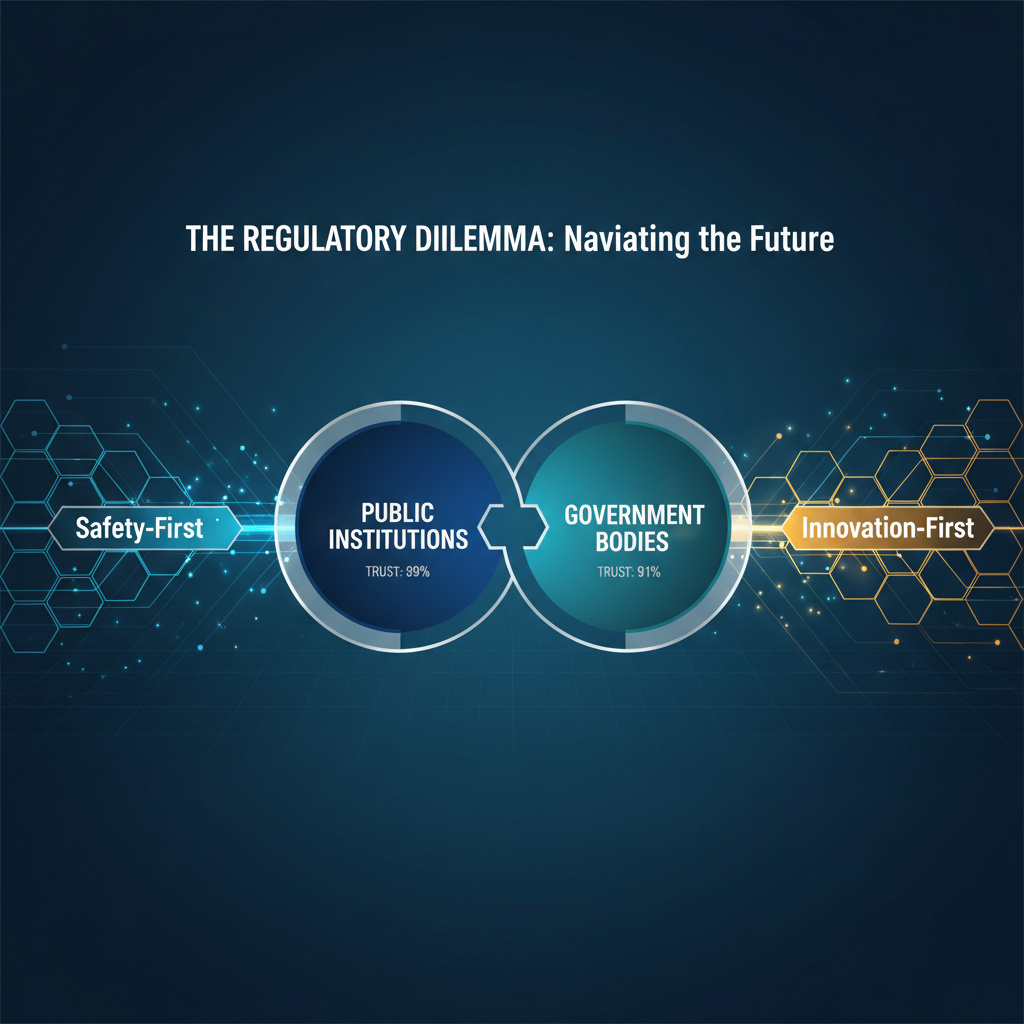
The UK government’s AI narrative centres on innovation, growth, and competitive advantage. The British public has a different priority: prove it’s safe first. This disconnect—revealed in striking detail by new research from the Ada Lovelace Institute—represents both a warning and an opportunity for businesses navigating AI adoption.
The Numbers That Should Change Your AI Strategy
The Ada Lovelace Institute’s December 2025 polling of 1,928 UK adults exposes a fundamental misalignment between policy rhetoric and public expectations. The findings aren’t merely interesting—they’re strategically significant for any organisation deploying AI.
Critical Context: This research was conducted in September 2025, capturing public sentiment during a period of rapid AI advancement and increasing mainstream awareness of both benefits and risks.
| Metric | Public Position | Strategic Implication |
|---|---|---|
| Safety over speed | 89% agree | Rushing deployment risks customer backlash |
| Fairness importance | 91% consider it important | Bias in AI outputs becomes a brand liability |
| Support ethical restrictions | 74% support | ”Move fast and break things” approach rejected |
| Demand independent regulation | 89% support | Self-governance claims viewed with scepticism |
| Distrust government on AI | 59% | Public seeks alternative sources of assurance |
| Distrust tech companies | 51% | Trust must be actively built, not assumed |
The gap between institutional confidence and public scepticism creates a credibility vacuum. Businesses that fill this vacuum with demonstrable transparency and accountability will capture market advantage.
What’s Actually Driving Public Resistance
The research reveals that public caution isn’t driven by technophobia or misunderstanding—it’s a rational response to perceived institutional failures.
The Exclusion Problem
Sixty percent of respondents don’t feel they have meaningful input on government decisions about AI. This isn’t passive discontent; it’s active alienation. When people feel excluded from decisions that affect their lives, they default to opposition rather than engagement.
Strategic Insight: Organisations that create genuine feedback mechanisms—not performative consultation—differentiate themselves from the institutional actors the public distrusts.
The Priorities Mismatch
Eighty-four percent worry the government will prioritise technology companies over public interest. This concern reflects a broader pattern: citizens observe policy decisions that appear to favour corporate interests while public concerns are dismissed as uninformed or obstructive.
The business implication is clear: alignment with perceived corporate-government consensus may damage rather than enhance credibility with customers and employees.
The Accountability Question
The public holds developers and regulators most accountable for AI harms—not end users. This represents a significant shift in expectations. Organisations cannot deflect responsibility onto users who “should have known better” or claim AI outputs are beyond their control.
Reality Check: When 86% support mandatory pre-market safety checks, “we’ll monitor and adjust” isn’t a viable public position. The expectation is demonstrated safety before deployment.
The Governance Gap: Why Current Approaches Fall Short
The research identifies specific governance failures that erode public confidence:
Voluntary measures rejected: Eighty-two percent prefer mandatory safety testing over voluntary industry commitments. Self-regulation is viewed not as responsible stewardship but as regulatory capture.
Regulatory toothlessness feared: Eighty-nine percent believe regulators should have power to halt harmful AI systems. Current UK regulatory frameworks, emphasising guidance over enforcement, don’t meet this expectation.
Transparency deficit: Eighty-five percent believe companies should disclose societal costs to the public. The gap between this expectation and current corporate communications practice represents a significant trust liability.
Hidden Cost: Organisations relying on regulatory minimalism as competitive advantage may find that advantage reversed as public pressure intensifies and more robust frameworks emerge.
Stakeholder Impact Analysis
| Stakeholder | Current Position | Public Expectation | Gap Severity |
|---|---|---|---|
| Government | Innovation-first | Safety-first | High |
| Large tech firms | Self-regulation | Independent oversight | High |
| Regulators | Advisory role | Enforcement powers | Medium-High |
| SMEs | Following enterprise lead | Direct accountability | Medium |
| Consumers | Passive acceptance | Active consent | Medium |
The highest-severity gaps exist at the institutional level, creating space for businesses that credibly differentiate their approach.
Strategic Recommendations for UK Businesses
The research suggests a clear strategic path for organisations seeking to build rather than erode trust.
Immediate Actions (0-30 Days)
Audit your AI communications: Review how you describe AI deployment to customers and employees. Does your language acknowledge safety considerations, or does it emphasise only efficiency and innovation? Messaging that ignores public concerns appears tone-deaf at best, deceptive at worst.
Document your governance: Can you articulate what safeguards exist before AI outputs reach customers? If not, create them. The expectation of pre-deployment safety testing applies regardless of whether regulators require it.
Take Action: Map every customer touchpoint where AI plays a role. For each, identify what could go wrong and what prevents it. Gaps in this exercise indicate governance gaps.
Medium-Term Priorities (30-90 Days)
Establish human oversight mechanisms: The public attributes accountability to developers and deployers, not end users. This means organisations must maintain meaningful human review of AI decisions affecting customers—particularly in high-stakes contexts like financial services, healthcare, or employment.
Create feedback channels: Don’t wait for complaints. Build systems that actively solicit input on AI performance from affected stakeholders. This addresses the exclusion problem while generating valuable improvement data.
Develop disclosure practices: The expectation of transparency about societal costs won’t disappear. Organisations that voluntarily disclose AI limitations, potential biases, and mitigation strategies position themselves ahead of likely regulatory requirements.
SME Advantage: Smaller organisations can implement genuine human oversight more readily than enterprises with fully automated pipelines. This represents a competitive differentiator worth emphasising.
Strategic Positioning (90+ Days)
Align with independent oversight: Rather than resisting regulatory development, consider proactive engagement. Organisations that help shape reasonable governance frameworks gain credibility while influencing outcomes.
Build evidence of responsible practice: The research shows 86% support mandatory pre-market safety checks. Organisations that can demonstrate equivalent rigour voluntarily—through documentation, testing records, and third-party validation—preempt criticism and build trust.
Four Challenges You’re Probably Not Anticipating
1. Employee Alignment
Your staff read the same headlines and share the same concerns as your customers. AI policies that employees view as prioritising efficiency over safety create internal friction, recruitment challenges, and potential whistleblower risks. Internal communication must address the values dimension, not just operational requirements.
2. Supply Chain Exposure
Your AI governance is only as strong as your weakest vendor. If you rely on third-party AI services, their governance failures become your reputation problems. Due diligence must extend beyond technical capability to governance practices.
Warning: ⚠️ “We didn’t know” is not a viable defence when 89% of the public expects accountability from deployers, regardless of where the AI originated.
3. The Documentation Imperative
Current informal AI adoption—staff using ChatGPT for drafts, Claude for analysis, Gemini for research—creates ungoverned exposure. Formalising these practices into documented policies isn’t bureaucracy; it’s risk management that will become table stakes.
4. Evolving Expectations
Public sentiment on AI is moving faster than policy. The expectations captured in this research will intensify, not moderate. Governance frameworks designed for today’s baseline will be inadequate for next year’s scrutiny. Build in mechanisms for continuous improvement, not one-time compliance.
The Strategic Imperative: Building Trust as Competitive Advantage
The Ada Lovelace Institute research reveals a fundamental truth: the UK public has internalised concerns about AI that many businesses haven’t yet confronted. This creates asymmetric risk—organisations operating on assumptions of public acceptance face potential backlash, while those who proactively address concerns build durable advantage.
Three Success Factors
-
Demonstrated accountability: Not claims of responsibility, but visible mechanisms—human oversight, audit trails, and clear escalation paths—that show accountability in practice.
-
Genuine transparency: Move beyond legal-minimum disclosure toward proactive communication about how AI is used, what could go wrong, and what safeguards exist.
-
Authentic engagement: Create real feedback mechanisms where stakeholder concerns inform practice, not consultation theatre that generates documentation but ignores input.
Strategic Reality: The 89% demanding safety over speed aren’t Luddites to be educated. They’re your customers, employees, and communities whose trust determines your social licence to operate.
Next Steps Checklist
- Review AI communications for alignment with public expectations
- Document current governance practices and identify gaps
- Establish human oversight for customer-facing AI applications
- Create stakeholder feedback mechanisms for AI performance
- Develop disclosure practices for AI limitations and safeguards
- Assess third-party AI vendors for governance alignment
- Formalise policies for employee AI tool usage
- Build continuous improvement mechanisms for governance frameworks
The organisations that thrive in an AI-enabled economy won’t be those that deploy fastest or automate most. They’ll be those that build genuine public trust through demonstrated responsibility. The research is clear: that trust cannot be assumed or manufactured. It must be earned.
Source: Polo, N. and Modhvadia, R. (2025) Great Expectations: Policy Briefing, Ada Lovelace Institute. Available at: adalovelaceinstitute.org/policy-briefing/great-expectations (Accessed: 20 January 2026).
Contact us to discuss how these findings apply to your organisation.