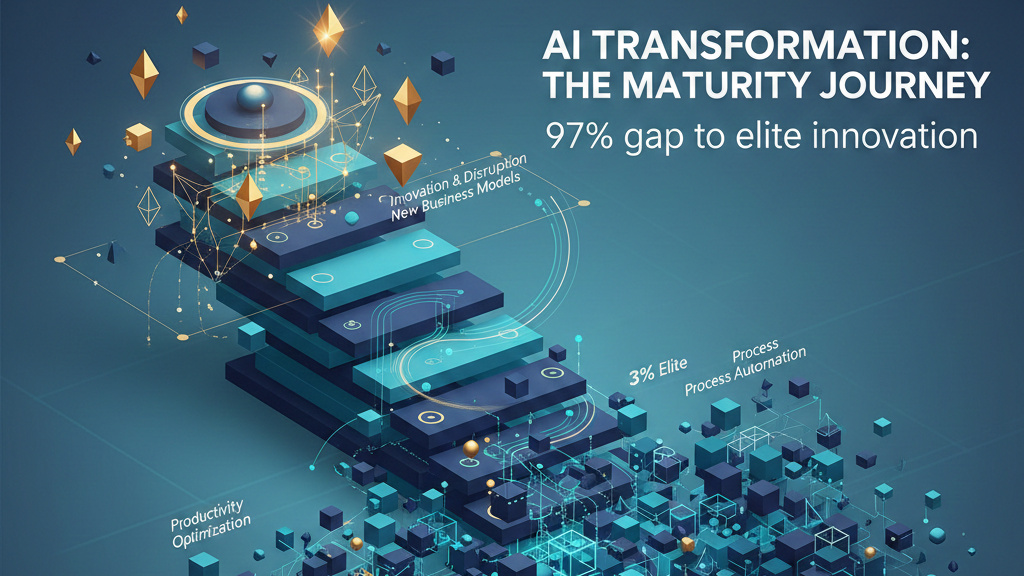
Only three per cent of organisations have genuinely transformed their operations with artificial intelligence—leaving 97% stuck in what Google’s latest research calls the “productivity trap,” where AI delivers incremental time savings but fails to unlock the innovation dividends that justify long-term investment.
The Executive-Employee Chasm
Google’s partnership with Hypothesis Group surveyed more than 2,500 business decision-makers and knowledge workers across six markets—the United States, United Kingdom, India, Japan, Brazil, and France—examining mid-market and enterprise organisations with 300 or more employees. The findings reveal a troubling pattern that should concern any leader banking on AI to drive competitive advantage.
Strategic Reality: Executives report significant AI impact whilst employees describe fragmented, experimental implementations—a perception gap that threatens adoption momentum across organisations of all sizes.
The disconnect is stark. Whilst executives express bullish confidence in AI’s transformative potential—viewing it as a cornerstone of growth strategy—employees tell a fundamentally different story. Despite using AI tools daily and recognising their career importance, workers perceive existing AI initiatives as experimental and disconnected from strategic priorities.
| Perspective | Executive View | Employee Experience |
|---|---|---|
| Current Impact | ”Already significant" | "Experimental and fragmented” |
| Strategic Priority | High confidence | Wants 84% more focus |
| Transformation Status | Optimistic | Reality lags perception |
| Adoption Success | Overstated | Under-supported |
This isn’t merely an internal communications challenge. When 84% of knowledge workers actively want their organisation to prioritise AI more heavily, yet feel unsupported by top-down strategy, robust training, and clear roadmaps, the stage is set for initiative fatigue and adoption stalls.
What the Three Per Cent Know
Google’s research identified five distinct levels of AI transformation, creating what functions as a maturity index. The findings offer uncomfortable reading for organisations assuming steady progress equals transformation.
Critical Context: Nearly three-quarters of organisations remain in early transformation stages—focused on encouraging adoption rather than embedding AI into operational DNA.
The fully transformed 3% share characteristics that separate them from the majority:
Breadth and Depth of Deployment: These organisations deploy AI across multiple departments simultaneously, not as siloed experiments. They’ve moved beyond pilot projects to organisation-wide implementation with clear interdependencies.
Innovation Over Efficiency: Whilst time savings provide the initial fuel, transformed organisations have progressed to using AI for product development acceleration, service innovation, and market expansion—strategic outcomes rather than operational quick wins.
Cultural Integration: AI isn’t a tool these organisations adopted; it’s become embedded in how work happens. Employees at every level understand AI’s role in their function, have clear guidelines for appropriate use, and receive ongoing support to maximise capability.
Success Factor: Transformation doesn’t follow a single path—but clear patterns emerge in the breadth and depth of use separating transformed organisations from those still getting started.
The Productivity Trap Explained
The research distinguishes between organisations saving time and those sparking innovation—a critical distinction with significant strategic implications.
Most organisations deploying AI achieve measurable productivity gains. Emails drafted faster. Documents summarised efficiently. Meeting notes generated automatically. These benefits are real, quantifiable, and increasingly expected as table stakes for competitive operations.
Hidden Cost: Focusing exclusively on efficiency gains creates a ceiling that prevents AI from delivering its transformative potential—whilst competitors who’ve broken through the productivity trap accelerate ahead.
But stopping at productivity creates several problems:
Diminishing Returns: Once obvious efficiency gains are captured, additional AI investment yields progressively smaller improvements. Without progression to innovation applications, ROI curves flatten.
Competitive Vulnerability: Organisations treating AI as purely an efficiency tool face rivals using it for product innovation, customer experience transformation, and market expansion. The productivity-focused organisation becomes faster at maintaining the status quo whilst competitors reshape the playing field.
Talent Expectations: Knowledge workers increasingly expect AI to enhance creativity and strategic contribution, not merely automate drudgery. Organisations stuck in the productivity trap struggle to attract and retain talent seeking meaningful AI-augmented roles.
The Strategy-Execution Gap
The research points to three critical failures preventing organisations from progressing beyond initial AI adoption:
Missing Top-Down Strategy
Employees consistently cite absence of clear strategic direction as the primary barrier. When AI initiatives emerge from individual departments or enthusiastic champions without executive alignment, fragmentation follows inevitably.
Implementation Note: A documented AI strategy with clear priorities, resource commitments, and success metrics creates the foundation for organisation-wide transformation—yet most organisations attempt transformation without this baseline.
Insufficient Training Investment
Providing AI tools without accompanying capability development creates the worst possible outcome: employees with powerful tools they lack confidence to use effectively, generating inconsistent results that undermine organisational trust in AI generally.
Unclear Roadmaps
Even organisations with stated AI priorities often lack sequenced implementation plans connecting current capabilities to future state ambitions. Employees describe feeling optimistic about AI’s potential whilst uncertain about their organisation’s specific path forward.
What the Research Recommends
Google’s findings suggest several interventions for organisations seeking to join the transformed 3%:
Embed AI in Productivity Tools
Organisations seeing stronger outcomes deployed AI within existing productivity and collaboration platforms rather than introducing standalone AI applications. Familiarity accelerates adoption; integration reduces friction.
SME Advantage: Smaller organisations can achieve rapid AI integration by focusing on tools already in daily use—adding AI capabilities to familiar workflows rather than introducing new platforms requiring behaviour change.
Define Innovation Targets
Moving beyond productivity requires explicit innovation objectives. What products could AI help develop faster? Which services could AI enhance? Where might AI reveal market opportunities currently invisible?
Close the Perception Gap
Executive optimism means nothing without employee experience alignment. Regular measurement of AI sentiment at all organisational levels—combined with responsive adjustments to training, support, and communication—ensures transformation momentum rather than stagnation.
Warning: ⚠️ Organisations that ignore the executive-employee perception gap risk building AI strategies on foundations of sand—appearing transformed from the boardroom whilst remaining stuck at ground level.
Strategic Implications for UK Businesses
The findings carry particular relevance for UK organisations navigating AI adoption amidst economic uncertainty and talent competition.
Resource Efficiency Imperative: With constrained budgets, UK businesses cannot afford AI investments that stop at productivity gains. The transformation premium—moving from time savings to innovation—becomes essential for justifying AI expenditure.
Competitive Positioning: UK organisations competing globally face rivals in markets with higher AI maturity levels. The research’s inclusion of India alongside established markets signals where competitive AI capability is emerging.
Talent Market Reality: UK knowledge workers expect AI-augmented roles. Organisations failing to progress beyond basic AI deployment risk losing talent to competitors demonstrating genuine transformation credentials.
The Path Forward
For organisations confronting the reality that they likely fall within the 97% yet to transform, the research suggests neither panic nor paralysis serves progress.
Take Action: Start by measuring the executive-employee perception gap within your own organisation. Understanding where you actually stand—rather than where leadership believes you stand—creates the foundation for meaningful strategy.
Immediate Actions:
- Conduct anonymous sentiment surveys measuring AI impact perception across organisational levels
- Document existing AI deployments, noting breadth across departments and depth within functions
- Identify where current AI use focuses on productivity versus innovation applications
Strategic Priorities:
- Develop or refine explicit AI strategy with executive sponsorship and measurable objectives
- Invest in training that builds confidence alongside capability
- Create clear roadmaps connecting current state to transformation ambitions
Innovation Focus:
- Define specific innovation targets beyond efficiency gains
- Pilot AI applications in product development, customer experience, or market analysis
- Measure and communicate innovation outcomes alongside productivity metrics
Connecting Research to Action
Google’s findings reinforce what practitioners observe across organisations of all sizes: AI transformation requires more than tool deployment. The 3% achieving genuine transformation have addressed strategy, training, culture, and application breadth simultaneously.
For organisations seeking to bridge the executive-employee gap and progress beyond productivity gains, strategic assessment provides the foundation for informed transformation planning. Understanding current state, identifying high-value opportunities, and creating actionable roadmaps distinguishes successful AI journeys from stalled experiments.
The 97% represents both challenge and opportunity. Challenge because most organisations remain far from transformation. Opportunity because the path forward is increasingly well documented—and the competitive advantage for early movers in genuinely transforming remains substantial.
Source: Beyond AI Optimism: Five ways to move your business from saving time to sparking innovation, Google Workspace in partnership with Hypothesis Group, 2025.
Strategic analysis by Resultsense.