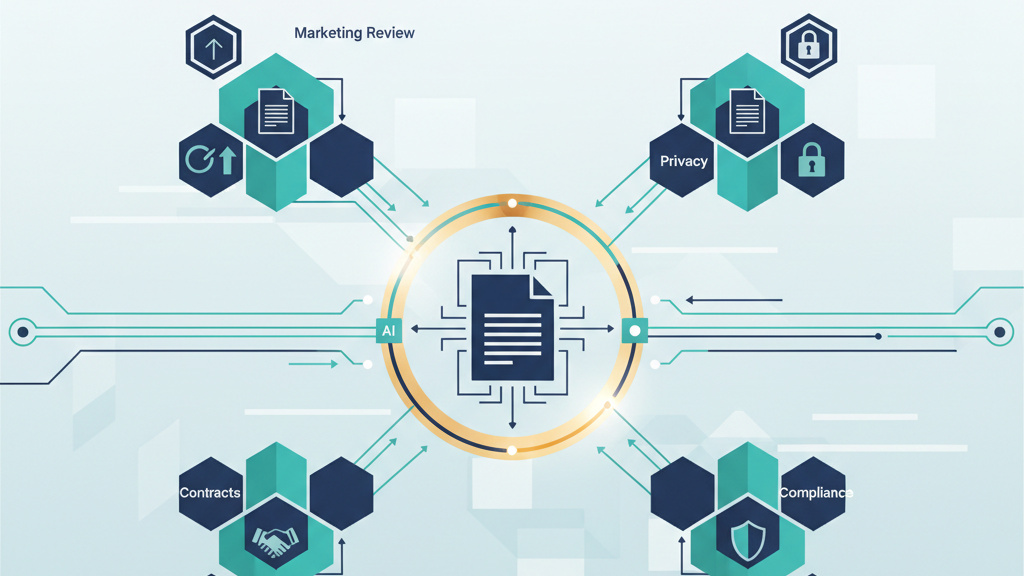
When Anthropic’s Associate General Counsel Mark Pike needed to solve the persistent bottleneck of marketing review delays, he didn’t reach for traditional legal technology. Instead, his team deployed four Claude-powered workflows that transformed legal operations without requiring a single line of code—and the results speak volumes about what’s possible when AI meets practical legal needs.
The Strategic Context: Why Legal Teams Are the Perfect AI Testing Ground
Legal departments across UK businesses share a common paradox: highly trained professionals spending significant portions of their day on repetitive, pattern-based tasks. Contract comparison, compliance checking, policy review—these activities follow predictable frameworks yet consume disproportionate legal resources.
Strategic Insight: Anthropic’s legal team started with pain points, not technology capabilities. They asked “what slows us down?” before asking “what can AI do?”
The Real Story Behind Legal AI Adoption
The conventional wisdom suggests legal work is too nuanced for AI automation. Anthropic’s experience demonstrates the opposite. Their four workflows address precisely the high-volume, pattern-based tasks that benefit most from AI augmentation:
| Workflow | Previous State | AI-Enabled State | Impact |
|---|---|---|---|
| Marketing Review | 2-3 days turnaround | 24 hours | ~80% faster |
| Contract Redlining | Manual comparison | Real-time highlights | Hours saved per contract |
| Conflict of Interest | Manual form review | Automated routing | Consistent compliance |
| Privacy Impact Assessments | Template recreation | Reference-based generation | Reduced duplication |
Critical Context: The most striking aspect isn’t the technology—it’s that legal team members with no coding background built these workflows themselves using natural language instructions.
What’s Really Happening: Inside the Four Workflows
Anthropic’s approach reveals a sophisticated understanding of where AI adds genuine value in legal operations. Each workflow targets a specific category of legal work.
Marketing Review: The Self-Service Model
Rather than creating another approval queue, the legal team built a Slack-pinned tool allowing marketers to pre-screen content themselves. The system checks for:
- Publicity rights compliance
- Trademark adherence
- Statistical accuracy verification
Implementation Note: This transforms legal from a bottleneck into a quality assurance layer. Marketers get instant feedback; lawyers review pre-filtered issues rather than every piece of content.
Contract Redlining: Cross-Platform Intelligence
Perhaps the most technically impressive workflow, the contract redlining tool operates across both Google Docs and Office 365. Claude compares document versions, highlights changes, and—crucially—suggests fallback language from the commercial playbook in real-time.
This isn’t simple track-changes functionality. The system understands contractual context, recognises common negotiation patterns, and provides guidance that previously required consulting a senior lawyer.
The Enabling Technology: Skills and MCP
Two technical concepts underpin Anthropic’s approach:
Skills: Instructional files that provide Claude with consistent, repeatable guidance. Think of these as sophisticated prompt templates that encode institutional knowledge—approved language, escalation criteria, brand guidelines—into reusable components.
MCP (Model Context Protocol): A method for connecting Claude to knowledge sources. For privacy impact assessments, MCP servers reference previous PIAs stored in Google Drive, enabling new assessments that match established templates and address recurring concerns.
Success Factor: The combination of Skills for consistency and MCP for institutional memory creates AI workflows that improve with use, not degrade.
The Human Factor: Why These Workflows Actually Work
The Anthropic legal team’s success hinges on understanding the proper role of AI in professional services. Every workflow maintains what they describe as “human oversight for verification”—AI handles the initial processing, humans make the final decisions.
Stakeholder Impact Analysis
| Role | Before AI Workflows | After AI Workflows | Net Benefit |
|---|---|---|---|
| Junior Lawyers | Routine review tasks | Complex analysis focus | Higher-value work |
| Senior Lawyers | Interrupt-driven queries | Exception handling | Strategic capacity |
| Marketing Team | Multi-day approval waits | Same-day feedback | Faster campaigns |
| Compliance | Reactive monitoring | Proactive routing | Risk reduction |
Reality Check: These workflows didn’t eliminate legal oversight—they elevated it. Lawyers now focus on genuine legal questions rather than administrative processing.
Success Criteria That Matter
Anthropic’s approach worked because they measured the right outcomes:
- Turnaround time: Measurable, immediate, visible to stakeholders
- Consistency: Same questions get same answers across team members
- Accessibility: Non-technical staff can use and understand the tools
- Maintainability: Workflows can be updated without developer involvement
Strategic Recommendations: Applying Anthropic’s Model to Your Organisation
The Anthropic legal team’s experience provides a replicable framework for UK businesses considering AI-enabled workflows.
Priority Actions by Organisational Maturity
Early Stage (No AI workflows)
- Identify your highest-volume, pattern-based professional tasks
- Document the decision criteria currently in experts’ heads
- Start with a single workflow where success is easily measured
- Ensure human review remains at critical decision points
Developing Stage (Some AI experimentation)
- Consolidate scattered AI tools into consistent workflows
- Create “Skills” (instructional files) encoding institutional knowledge
- Establish clear metrics for measuring AI workflow performance
- Build governance frameworks before scaling
Advanced Stage (Multiple AI workflows)
- Connect workflows to institutional knowledge via MCP or similar protocols
- Create feedback loops where workflow outputs improve source materials
- Develop role-specific interfaces for different user groups
- Document and share learnings across departments
SME Advantage: Smaller organisations can implement these approaches faster than enterprises. Less bureaucracy means quicker iteration cycles and more direct feedback loops.
Implementation Framework
Phase 1: Discovery (Week 1-2)
├── Map highest-friction workflows
├── Document current decision criteria
└── Identify measurable success metrics

Phase 2: Pilot (Week 3-4)
├── Build single workflow with natural language
├── Test with limited user group
└── Gather feedback and iterate

Phase 3: Scale (Week 5-8)
├── Expand successful workflows
├── Create Skills for consistency
└── Connect to knowledge sources

Phase 4: Optimise (Ongoing)
├── Monitor performance metrics
├── Update Skills as knowledge evolves
└── Expand to adjacent use cases
The Hidden Challenges Nobody Mentions
Anthropic’s published experience highlights successes, but implementing similar workflows requires navigating several non-obvious challenges.
Challenge 1: Knowledge Extraction
Creating effective “Skills” requires extracting tacit knowledge from experienced professionals—often people who don’t realise how much they know or struggle to articulate their decision-making process.
Mitigation: Interview experts while they work. Ask “why did you do that?” rather than “how do you do this?” Real-time observation captures nuances that post-hoc descriptions miss.
Challenge 2: Edge Case Proliferation
AI workflows excel at common scenarios but may struggle with unusual situations. Legal work, by nature, often involves precisely these edge cases.
Mitigation: Build explicit escalation paths into every workflow. When AI confidence drops below threshold, route to human review automatically. Accept that some categories of work shouldn’t be AI-processed.
Challenge 3: Maintaining Accuracy Over Time
AI outputs can drift as models update, source materials change, or business requirements evolve. Yesterday’s reliable workflow may produce tomorrow’s compliance issue.
Mitigation: Establish regular review cycles for AI workflows, ideally quarterly. Include spot-checking as standard practice, not exceptional audit.
Warning: ⚠️ The most dangerous AI workflow is one that worked well initially and is now trusted without verification. Build monitoring into operations from day one.
Challenge 4: Change Management
Technical implementation is often easier than cultural adoption. Teams accustomed to traditional workflows may resist AI-enabled alternatives, even superior ones.
Mitigation: Start with enthusiastic early adopters. Let peer success drive broader adoption rather than mandating use. Highlight time savings in terms people care about—leaving on time, fewer weekend interruptions, focus on interesting work.
Strategic Takeaway: The Professional Services AI Playbook
Anthropic’s legal team has demonstrated that AI-enabled professional workflows aren’t theoretical future possibilities—they’re practical present realities available to any organisation willing to approach implementation thoughtfully.
The Core Value Proposition
AI in professional services succeeds when it amplifies human expertise rather than attempting to replace it. The Anthropic model works because it:
- Handles volume, not judgement
- Provides consistency, not creativity
- Enables speed, not shortcuts
- Maintains oversight, not automation
Three Success Factors
- Start with pain, not technology: The best AI workflows solve real problems that real people actually have
- Encode expertise, don’t assume it: AI needs your institutional knowledge made explicit through Skills and connected knowledge sources
- Measure what matters: Turnaround time, consistency, and user adoption tell you whether workflows actually work
Your Next Steps Checklist
- Identify your three highest-volume professional tasks that follow predictable patterns
- Document the decision criteria currently stored only in experts’ heads
- Select one workflow for initial pilot based on measurable success criteria
- Establish human review points before any AI workflow goes live
- Define monitoring metrics before deployment, not after
Source: Pike, M. (2025) ‘How Anthropic’s legal team cut review times from days to hours with Claude’, Claude Blog, 8 December. Available at: https://claude.com/blog/how-anthropic-uses-claude-legal
This strategic analysis was written by Resultsense, a UK-focused AI news and analysis publication. We will keep watching which professional review tasks get automated and which stay with people. Read more analysis at Insights, or get in touch.